Your Cleanroom Specialist
Competence from + 100 Cleanrooms and since 1992
Cleanroom 14644 ISO 1-9 FS209E EU GMP ABCD USP 797, 800, 825
Cleanroom Design, Construction, Operation
Limit Your Liability
Cleanroom End User
Limit Your Liability - I make sure that Your Cleanroom project meets Your demands, from Design to Operation.
Architects
Limit Your Liability- I make sure that Your Cleanroom Specification will meet the End Customer needs, and at the right budget/cost.
Contractors
Limit Your Liability- I make sure that all building processes are aligned, in line with the Cleanroom demand.
Consulting Engineers
Limit Your Liability- I offer extended Cleanroom competence
Alata
Alice
Open Sans
Noto Sans
Bebas Neue
Great Vibes
Rock Salt
Exo
Belgrano
Overlock
Cinzel
Indie Flower
Staatliches
Roboto Slab
Lato
Noto Serif
Open Sans
Montserrat
Ubuntu
Rubik
Delius
Amiri
Montserrat
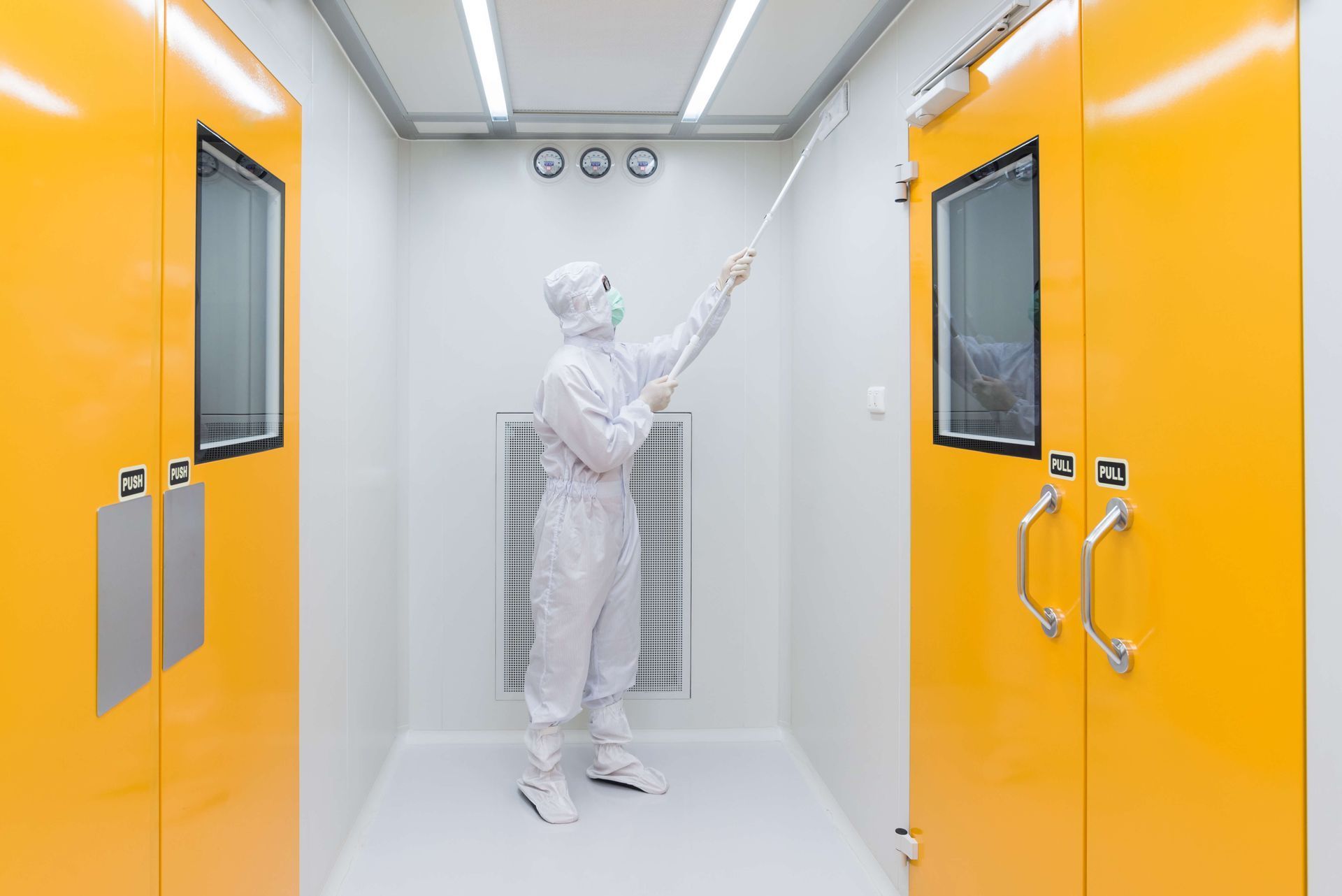
Cleanroom Commissioning: Integrating Building Services and Process Requirements 1. Introduction Cleanroom commissioning is a structured, engineering-driven process that ensures building services, HVAC systems, automation controls, and process-specific requirements are harmonized before qualification and routine operation. While ISO 14644 defines the performance criteria and GMP Annex 1 establishes regulatory expectations, commissioning verifies that the facility’s mechanical, electrical, and control systems have been functionally tested, documented, and optimized to support cleanroom performance. Effective commissioning reduces qualification risk, compresses project timelines, and provides a reliable foundation for DQ–IQ–OQ–PQ activities. This article outlines a technically rigorous approach to commissioning cleanrooms by integrating building services with process and operational needs. 2. Commissioning Objectives and Scope Cleanroom commissioning goes beyond standard HVAC commissioning by incorporating contamination-control, process compatibility, and regulatory compliance considerations. Primary objectives include: Confirming that building services deliver the environmental conditions required by the URS. Verifying that HVAC, electrical, monitoring, and automation systems perform according to design intent. Ensuring seamless integration of process equipment, personnel flow, and material flow. Establishing documented evidence that supports subsequent IQ/OQ/PQ activities. Commissioning scope typically covers mechanical (HVAC), electrical, process utilities, automation, controls, fire protection, and architectural systems relevant to environmental stability. 3. Relationship Between Commissioning and Qualification Commissioning and qualification are distinct but interdependent processes. Commissioning verifies functional performance and ensures systems operate safely, reliably, and in accordance with the design. Qualification demonstrates that the facility meets regulatory, contamination-control, and process requirements defined in the URS and CCS. A well-executed commissioning effort reduces qualification deviations, accelerates OQ, and provides high-quality baselines for PQ. 4. Commissioning Workflow Structure A structured commissioning plan provides transparency, traceability, and alignment with design requirements. Typical stages include: Pre-Commissioning: Documentation review, installation checks, and power-up inspections. Static Commissioning: Verification of mechanical and electrical installation quality. Dynamic Commissioning: Functional testing under powered and operational conditions. Integrated Systems Testing (IST): Validation of system-to-system interactions, including alarms, interlocks, and fail-safes. Handover to Qualification: Compilation of commissioning results and resolution of deficiencies. Each stage must be traceable to the design documents, URS, and Basis of Design (BOD). 5. HVAC Commissioning Essentials HVAC systems are the backbone of cleanroom environmental control. Commissioning must demonstrate that airflow, pressure, temperature, and humidity targets are reliably achievable. Critical HVAC commissioning activities: Airflow verification: Measuring supply, return, and exhaust volumes to confirm balance and cascade stability. Pressure cascade establishment: Testing differential pressures between zones under at-rest and disturbed conditions. Filter installation integrity: Ensuring HEPA/ULPA filters and housings are correctly seated before OQ integrity testing. Damper and control valve tuning: Aligning actuator positions and control algorithms with design assumptions. Thermal stability verification: Confirming temperature and humidity responsiveness under varying loads. Mechanical commissioning data form the baseline for OQ environmental verification. 6. Integration of Building Automation and Monitoring Systems Cleanrooms rely on automation for stable control of critical environmental parameters. Key commissioning considerations: BMS/EMS functional testing: Verifying setpoint control, signal scaling, trending, and alarm logic. Interlocks and dependencies: Testing door interlocks, pressure-loss alarms, fan failures, and safe-shutdown sequences. Sensor calibration: Ensuring pressure, temperature, humidity, and airflow sensors are calibrated and traceable. Redundancy and failover: Validating that redundant fans, UPS systems, or emergency power supplies respond appropriately. Automation commissioning provides the functional evidence required to support qualification, monitoring strategy development, and ongoing lifecycle control. 7. Integration of Utility and Process Services Process utilities must operate in harmony with the cleanroom environment, especially in GMP-regulated facilities. Core utility commissioning activities include: Clean utilities: Verifying functionality of compressed air, chilled water, process gases, and vacuum systems. Gowning and hygiene facilities: Ensuring airlocks, sinks, and hand dryers support contamination-control workflows. Waste and exhaust systems: Confirming containment and flow direction for hazardous or high-particulate loads. Lighting and emergency systems: Ensuring visual quality and safety without introducing contamination or turbulence. Utility commissioning ensures the cleanroom can support full process operations without compromising environmental conditions. 8. Architectural and Envelope Commissioning The cleanroom envelope establishes the physical barriers needed to control contamination and maintain pressurization. Key architectural commissioning checks: Verification of panel integrity, sealing, and non-shedding finishes. Door alignment, closure force, and leakage performance. Integrity of glazing, pass-throughs, and service panels. Surface continuity, cleanability, and compliance with hygienic design principles. Access to mechanical spaces without exposing clean areas to uncontrolled contamination. Architectural performance strongly influences the ability to maintain pressure cascades and achieve classification targets. 9. Integrated Systems Testing (IST) IST validates the full interaction of cleanroom subsystems under realistic scenarios. This is particularly important for GMP facilities where system interdependencies affect contamination control. Typical IST tests include: Power failure and restoration: Verifying controlled shutdown and recovery of HVAC, monitoring, and interlocks. Fire alarm activation: Confirming damper positioning, pressurization shifts, and emergency responses. Door operation simulations: Evaluating transient pressure responses and interlock performance. Equipment heat-load simulation: Testing environmental stability under modeled process conditions. HVAC-facility coordination: Ensuring airflow patterns remain stable when multiple units ramp up or modulate. IST results are essential inputs for OQ/PQ risk assessment. 10. Documentation and Traceability Commissioning documentation must be complete, organized, and traceable to support qualification and regulatory audits. Required documentation typically includes: Commissioning plans, protocols, and test scripts. Installation and functional verification records. Calibration certificates and equipment lists. As-built drawings, control sequences, and airflow balance reports. Deficiency logs and corrective actions. Final commissioning summary report. A thorough documentation package reduces ambiguity during qualification and provides clear evidence of engineering due diligence. 11. Transition to Qualification (IQ–OQ–PQ) After commissioning, qualification teams rely on the commissioning data as verified baselines. Linkages include: IQ: Uses installation records, calibration data, and as-built documentation. OQ: Builds on airflow, pressure, and control-system performance data to verify environmental conditions. PQ: Relies on operational insights from IST and utility tests to validate process performance. A seamless transition between commissioning and qualification minimizes rework and enhances regulatory compliance. 12. Conclusion Cleanroom commissioning is a critical step in ensuring that building services and process requirements form a cohesive, fully functional system before regulatory qualification. By rigorously testing HVAC, automation, utilities, and architectural components—and by validating their interactions through IST—commissioning provides the technical foundation for reliable cleanroom performance. When executed with precision and clear documentation, commissioning strengthens contamination control, reduces risk, and enhances the long-term operational stability of regulated facilities. Read more here: About Cleanrooms: The ultimate Guide

Precision Control of Pressure Cascades in Multi-Zone Facilities 1. Introduction Pressure cascades are a foundational element of contamination control in multi-zone cleanroom facilities. Whether the target is protecting sterile products, preventing cross-contamination, or ensuring environmental containment, the ability to maintain well-defined differential pressures between adjacent rooms is essential for compliance with ISO 14644 , GMP Annex 1 , and sector-specific regulatory frameworks. Precision pressure control enables directional airflow from cleaner to less clean (or, in containment applications, the reverse), ensuring that contaminants cannot migrate across boundaries. This article presents a technically robust, engineering-focused overview of strategies for designing, implementing, and maintaining stable pressure cascades in complex cleanroom environments. 2. Fundamentals of Pressure Cascade Design A pressure cascade establishes a controlled airflow direction between rooms. Cleanrooms typically maintain positive pressure relative to surrounding areas, whereas containment suites (e.g., cytotoxic or BSL environments) may maintain negative pressure to prevent hazardous material release. Key engineering objectives: Maintain defined pressure differentials, commonly 10–15 Pa between critical cleanroom grades and ≥5 Pa between support zones. Ensure airflow directionality remains stable under expected operational conditions, including personnel movement and door cycling. Integrate pressure control with the overall heating, ventilation, and air conditioning (HVAC) strategy and with the facility’s Contamination Control Strategy (CCS). Pressure cascades must be defined during Design Qualification (DQ) and supported by detailed airflow and balance calculations. 3. Determining Target Pressure Differentials Target values depend on regulatory classification, process risk, and architectural constraints. Common industry values: ISO 5 → ISO 7 transitions: 10–15 Pa positive differential. ISO 7 → ISO 8 transitions: 5–10 Pa. Cleanroom envelope → unclassified areas: 10–30 Pa, depending on infiltration risk. Containment zones (negative pressure): –25 to –50 Pa relative to adjacent safe areas, depending on hazard classification. Selection of pressure levels must consider: Leakage paths (e.g., door margins, pass-throughs, panel joints). HVAC supply/exhaust balance requirements. Structural constraints that affect room airtightness. Safety factors for peak infiltration during operations. 4. Supply, Return, and Exhaust Balance Strategies Achieving stable pressure requires precise control of volumetric airflow. Primary balancing strategies: Supply-dominant control (positive pressure zones): Supply airflow exceeds return/exhaust. Exhaust-dominant control (negative pressure zones): Exhaust exceeds supply to maintain containment. Neutral-buffered rooms: Used between zones where either excessive positive or negative pressure would be undesirable. Engineering calculations must account for: Door leakage rates at closed and partially opened conditions. Equipment penetrations and pass-throughs. Variability in FFU and terminal HEPA performance curves. Seasonal density changes in supply air that affect mass flow. Airflow balance typically forms the basis for both initial HVAC design and control-system tuning during OQ. 5. Control System Architecture for Pressure Regulation Modern pressure cascades rely on a combination of hardware and control strategies to ensure stability under dynamic conditions. Essential system components: Differential pressure sensors: High-accuracy transmitters with calibration traceability, placed between each zone pair. Variable Air Volume (VAV) boxes: Modulate supply or return airflow to maintain the setpoint. Exhaust control valves/dampers: Particularly critical in negative-pressure zones. Airflow monitoring stations: Provide mass-flow verification for high-precision control loops. Building Management System (BMS) or EMS integration: Enables setpoint enforcement, alarms, trending, and interlocks. Control strategies: Cascade control loops: Primary (pressure) loop driving secondary (airflow) loops for improved response. Direct supply modulation: Adjusts supply airflow to maintain pressure. Return modulation: Often used where supply airflow must remain stable for temperature or humidity control. Hybrid strategies: Combining supply and return modulation for high-stability applications such as Grade B aseptic areas. 6. Managing Dynamic Conditions and Transients Door openings, personnel movement, and equipment operation introduce transient disturbances that can destabilize pressure cascades. Engineering techniques to manage transients: Airlock design: Provides staged pressure transitions and minimizes direct room-to-room pressure impacts. Interlocked doors: Prevent simultaneous opening of two doors within airlocks. High-response actuators and VAVs: Reduce pressure drift during sudden disturbances. Buffer airflow: Slight over- or under-supply margin to absorb transient conditions. Door automation: Slow-open/slow-close mechanisms reduce airflow shock loads. Transient simulations—either through CFD or simplified airflow modelling—are valuable during DQ for assessing worst-case scenarios. 7. Architectural Airtightness and Leakage Control Room leakage strongly influences achievable pressure stability and energy efficiency. Best practices: Seal all penetrations, utility lines, electrical conduits, and panel joints with low-VOC, non-shedding sealants. Use gasketed, tight-tolerance cleanroom doors with verified leakage rates. Minimize uncontrolled leakage paths within wall systems, ceiling voids, and raised floors. Validate airtightness through room pressure decay tests where appropriate. Improving airtightness often reduces the airflow required to maintain pressure differentials, lowering lifecycle operating costs. 8. Sensor Placement and Calibration Strategies Accurate pressure control depends heavily on proper placement and maintenance of differential pressure sensors. Placement guidelines: Sensors should measure pressure between rooms directly, not relative to corridor air that may fluctuate. Install measurement ports away from supply diffusers and high-velocity zones to avoid local bias. Maintain consistent elevation when comparing multiple sensors for cascade alignment. Calibration considerations: Perform initial calibration during IQ with traceable standards. Recalibrate at intervals defined by risk assessment—typically 6–12 months. Verify readings during every OQ using calibrated reference instruments. 9. Integration With Environmental Monitoring and Alarms Pressure differentials are classified as critical or major environmental parameters depending on the process. Monitoring systems must provide continuous assurance. Key features for compliant systems: Real-time trending with audit trails. Alarm setpoints with justified action/alert limits (e.g., 10 Pa target with 6 Pa alert and 4 Pa action). Door status logging to correlate excursions with operational events. Interlocks that deactivate operations or signal operators when pressure falls below safe limits. Proper alarm integration is a requirement under GMP Annex 1 to ensure ongoing contamination control. 10. Verification and Qualification of Pressure Cascades Pressure cascade performance must be demonstrated through structured qualification activities. During OQ: Measure differential pressure stability under at-rest conditions. Verify response time to disturbances such as door openings. Confirm that airflow balancing matches design assumptions used in DQ. During PQ: Validate pressure maintenance during real operations including personnel activity and equipment heat loads. Demonstrate that pressure excursions do not compromise ISO classification or contamination control. Collect baseline pressure-trending data for future monitoring comparisons. Qualification outcomes must be linked to URS requirements and documented in the facility’s CCS. 11. Lifecycle Maintenance and Requalification Maintaining an effective pressure cascade requires ongoing attention. Key elements: Annual requalification of pressure measurements. Periodic inspection and recalibration of pressure transmitters. Verification of air balance following any HVAC or architectural change. Routine inspection of door seals, gaskets, and damper positions. Trend analysis to identify drift or instability. A robust change-control process is essential; even small modifications, such as replacing a door or altering exhaust ducting, may require partial requalification. 12. Conclusion Precision control of pressure cascades is central to maintaining contamination-control integrity in multi-zone cleanroom facilities. Through careful design, accurate airflow balancing, reliable control hardware, and rigorous qualification, engineers can ensure that cleanrooms consistently achieve the pressure differentials required by ISO 14644 and GMP Annex 1. A disciplined approach supports operational stability, reduces contamination risk, and strengthens long-term regulatory compliance across the cleanroom lifecycle. Read more here: About Cleanrooms: The ultimate Guide

Advanced Airflow Modelling: Applying CFD in Cleanroom Design 1. Introduction Computational Fluid Dynamics (CFD) has become an essential tool for engineering cleanrooms that meet stringent performance, contamination-control, and regulatory requirements. While ISO 14644 and GMP Annex 1 provide the performance criteria, CFD enables engineers to predict airflow behavior—velocity fields, turbulence, particle transport, and temperature distribution—before construction or modification of a cleanroom. When properly validated, CFD strengthens design decisions, reduces lifecycle risk, and improves operational reliability. This article provides a technically grounded, engineer-focused guide to using CFD in modern cleanroom design, from modelling strategy to validation and integration with qualification activities. 2. The Role of CFD in Cleanroom Engineering CFD supplements traditional engineering calculations by offering a detailed, three-dimensional understanding of airflow patterns. In cleanrooms where unidirectional flow, pressure cascades, and contamination pathways are critical, CFD offers insights that are not achievable through rule-of-thumb design alone. Primary uses of CFD in cleanroom design include: Predicting airflow velocity profiles and identifying turbulence zones. Visualizing unidirectional flow uniformity over process-critical areas. Simulating particle generation, transport, and deposition. Optimizing placement of HEPA filters, returns, and make-up air inlets. Assessing temperature, humidity, and buoyancy-driven effects in high-load areas. Supporting contamination-control risk assessments and the facility’s Contamination Control Strategy (CCS). CFD is not a substitute for compliance testing; rather, it improves the likelihood that the constructed facility will meet ISO 14644 performance criteria during OQ/PQ. 3. Modelling Objectives and Boundary Conditions Accurate CFD results depend on well-defined modelling goals and boundary conditions that reflect real operational expectations. Typical modelling objectives include: Achieving consistent unidirectional airflow ≥0.36–0.54 m/s over ISO 5 zones. Maintaining required pressure differentials (generally 10–15 Pa between grades). Minimizing recirculation zones above critical process locations. Verifying recovery time following simulated particle disturbances. Predicting environmental stability near heat-emitting equipment. Essential boundary conditions: Supply airflow: HEPA/ULPA face velocities, FFU performance curves, and uniformity assumptions. Exhaust/return flow: Locations, flow rates, and balance settings. Thermal loads: People, equipment, lighting, and process heat sources. Process barriers: Isolators, RABS, curtains, and equipment footprints. Contaminant sources: Personnel particle emission rates and process-specific generation assumptions. Boundary conditions must be based on engineering calculations, manufacturer data, and documented URS/Basis of Design (BOD) criteria. 4. Turbulence Models and Solver Selection Selecting an appropriate turbulence model is one of the most critical decisions in cleanroom CFD because the accuracy of particle transport and velocity uniformity predictions depends heavily on it. Commonly applied models: k–ε (standard or realizable): Robust for general room-scale modelling; good balance between accuracy and computation time. k–ω SST: Better near-wall resolution; useful for unidirectional flow uniformity and identifying micro-recirculation zones. RNG k–ε: Helpful where buoyancy and swirl effects are present. LES (Large Eddy Simulation): High accuracy but computationally intensive; typically reserved for research-level or high-risk applications. For most cleanroom design projects, a realizable k–ε or k–ω SST model achieves the necessary practical accuracy while maintaining reasonable simulation times. 5. Particle Transport and Contamination Modelling Simulating particle movement allows engineers to assess contamination risks early in design. Two principal approaches exist: Lagrangian (discrete particle) modelling: Tracks individual particles; useful for simulating personnel-generated contamination and verifying whether particles escape critical zones. Eulerian (scalar concentration) modelling: Treats particle concentration as a continuum; suitable for evaluating uniformity or dilution in larger volumes. Key considerations: Use iso-kinetic boundary conditions near HEPA inlets to avoid artificial deposition. Apply realistic particle size distributions (commonly 0.5–5 µm for viable and 0.3–5 µm for non-viable particles). Incorporate gravitational settling and turbulent dispersion when modelling deposition risk. Particle simulation results should be cross-checked with anticipated ISO 14644-1 class limits and expected PQ operational performance. 6. Modelling Common Cleanroom Configurations Different room layouts and process arrangements require tailored CFD approaches. Unidirectional (laminar) airflow zones: Evaluate face velocity uniformity and identify edge effects near walls and equipment. Examine the influence of obstructions such as robots, filling lines, or microscopes. Confirm downward flow continuity to low-wall returns. Turbulent-mixed airflow rooms: Model dilution effectiveness, especially in ISO 7–8 rooms with high heat loads. Verify that return locations do not create stagnant corners. Airlocks and transfer rooms: Simulate opening/closing cycles using transient models to predict pressure cascade stability. Assess air velocity through door gaps for contamination containment. RABS and isolator environments: Model internal recirculation patterns and assess glove port disturbances. Evaluate leakage paths between zones and HEPA supply interactions. 7. CFD Integration in the Cleanroom Design Workflow CFD should not be an isolated task; it must integrate with the broader engineering design and qualification lifecycle. Typical workflow alignment: URS & DQ: CFD supports design decisions for HEPA placement, supply air volume, and equipment layout. IQ: Ensures installation matches the design assumptions used in the model. OQ: CFD predictions are verified using airflow visualization, smoke studies, HEPA integrity tests, and velocity measurements. PQ: CFD results help interpret operational classification testing and particle behaviour under dynamic conditions. CFD findings should feed into the facility’s CCS, particularly around critical interventions, airflow protection strategies, and environmental monitoring locations. 8. Validation and Verification of CFD Models Regulatory expectations require that CFD models used for design or risk assessment be validated against real data. Core verification steps: Compare predicted velocities with measured values during OQ. Validate pressure gradients using HVAC commissioning data. Confirm predicted flow patterns with smoke visualization. Cross-check predicted contamination trends with PQ results. Documentation should include model setup, assumptions, solver settings, mesh strategy, convergence criteria, and deviations from standard practice. 9. Limitations and Engineering Considerations Although powerful, CFD is not infallible and must be applied with engineering judgement. Known limitations: Over-simplified boundary conditions can lead to false uniformity. Turbulence models vary in accuracy for low-velocity, cleanroom-specific flows. Mesh resolution significantly affects results; inadequate meshing may hide recirculation. CFD cannot replace ISO 14644 testing, HEPA integrity testing, or real PQ performance data. Well-designed CFD complements, but never substitutes, field testing. 10. Conclusion CFD has become a cornerstone of advanced cleanroom design, enabling engineers to visualize airflow behaviour, predict contamination risks, and optimize HVAC performance before construction. When grounded in accurate boundary conditions, suitable turbulence models, and validated assumptions, CFD provides actionable insights that significantly improve the reliability and regulatory robustness of cleanroom design. By integrating CFD throughout the DQ–IQ–OQ–PQ lifecycle, cleanroom designers and operators can achieve systems that meet ISO 14644 and GMP Annex 1 requirements with greater confidence, efficiency, and long-term performance stability. Read more here: About Cleanrooms: The ultimate Guide