Advanced Filtration Technologies for Cleanroom Air Quality
Advanced Filtration Technologies for Cleanroom Air Quality
1 Introduction
Advanced filtration technologies are central to achieving and maintaining cleanroom air quality. Cleanrooms depend on engineered airflow systems and high-efficiency filters to control particulate and microbial contaminants, protect sensitive processes, and meet ISO 14644 classification requirements. As industries adopt more precise manufacturing techniques and tighter environmental specifications, filtration systems must deliver higher performance, improved energy efficiency, and consistent reliability.
This article explains the filtration technologies that underpin modern cleanroom air systems, their engineering principles, and the considerations required for compliant, stable operation.
2 The Role of Filtration in Cleanroom Performance
Cleanroom air quality is determined largely by how effectively airborne particles are removed from supply air. Even state-of-the-art HVAC systems cannot maintain classification levels without properly selected, installed, and maintained filtration stages.
Filtration supports:
- ISO 14644 particle concentration compliance across various size thresholds.
- Stable airflow patterns, including laminar flow in critical zones.
- Protection of sensitive equipment and product surfaces from particulate deposition.
- Reduction of microbial load, especially in sterile and aseptic environments.
- Sustained performance under continuous, high-volume air exchange rates.
Because filtration directly affects cleanroom stability, it must be engineered as part of an integrated HVAC and contamination-control strategy.
3 Pre-Filtration: The First Line of Defense
Pre-filters protect HEPA and ULPA filters from premature loading by capturing larger particles.
Common pre-filter technologies include:
- MERV 8–11 pleated filters for coarse dust and lint.
- Bag filters or cartridge filters for higher holding capacity.
- MERV 13–15 intermediate filters when extended HEPA life is required.
Pre-filtration reduces operating costs by extending the service life of final filters, stabilizes airflow, and maintains HVAC efficiency. Properly staged filtration is especially important in facilities with high outdoor air requirements or significant particulate burden.
4 HEPA Filtration: The Core Cleanroom Technology
High-Efficiency Particulate Air (HEPA) filters are the standard final filters for most cleanroom classifications.
Performance characteristics:
- Minimum efficiency of 99.97% at 0.3 µm (the MPPS—Most Penetrating Particle Size).
- Typically constructed from microfiberglass media formed into deep pleats.
- Designed to capture particulates via diffusion, interception, and inertial impaction.
Applications:
- ISO 5–8 cleanrooms
- Semiconductor fabs
- Biopharmaceutical and aseptic processing areas
- Medical device assembly
Engineering considerations:
- Filters are installed in Terminal HEPA housings or Fan Filter Units (FFUs).
- All HEPA filters require on-site leak testing (DOP/PAO testing) during installation and routine maintenance.
- Pressure drops must be monitored to maintain required airflow and differential pressures.
HEPA filters remain the industry standard due to their proven effectiveness, reliability, and cost-efficiency.
5 ULPA Filtration: Ultra-High Efficiency for Critical Applications
Ultra-Low Penetration Air (ULPA) filters provide efficiencies of 99.999% at 0.1–0.2 µm, making them suitable for the most sensitive environments.
Where ULPA filters are used:
- ISO 4 and ISO 3 cleanrooms
- Nanofabrication and microelectronics
- High-end pharmaceutical isolators
- Specialty R&D requiring ultra-clean environments
Advantages:
- Enhanced capture of submicron particles and aerosols.
- Support for ultra-low contamination thresholds in precision processes.
Limitations:
- Higher pressure drop and energy consumption.
- Stricter installation tolerances.
- Generally shorter service life than HEPA filters.
ULPA filters are selected only when process requirements justify the increased operational cost.
6 Fan Filter Units (FFUs) and Distributed Filtration
Fan Filter Units integrate a fan with a HEPA or ULPA filter, providing localized clean air delivery.
Benefits:
- Modular and scalable cleanroom layouts.
- Independent control of airflow to each unit.
- Easier retrofits and reduced ductwork requirements.
- Suitable for ISO 5 and ISO 6 environments where airflow predictability is critical.
Engineering considerations:
- FFUs must be selected for low vibration, low noise, and energy efficiency.
- Airflow uniformity must be verified with velocity mapping.
- FFU maintenance schedules must include motor inspections and filter integrity testing.
FFUs are common in semiconductor, optical, and medical-device cleanrooms utilizing grid-based ceiling systems.
7 Advanced Media Technologies
Filtration performance is influenced by the media used within filters. Modern technologies improve particle capture efficiency, reduce resistance, and extend filter life.
Notable media types include:
- Microglass fibers: Traditional, highly effective HEPA and ULPA media.
- PTFE membranes: Low resistance, robust chemical compatibility, and suited for humid environments.
- Nanofiber coatings: Enhance particle capture while reducing initial pressure drop.
- Electrostatically charged media: Used mainly in pre-filtration to increase efficiency without added resistance.
Choosing the right filter media ensures compatibility with airflow rates, temperature, humidity, and chemical exposure.
8 Molecular Filtration for VOC and Gas Control
Some cleanrooms require removal of volatile organic compounds (VOCs) or corrosive gases that can damage products or equipment.
Common molecular filtration media include:
- Activated carbon for VOC adsorption.
- Chemically impregnated media for acid, base, or oxidizer removal.
- Hybrid filters combining particulate and molecular filtration in one housing.
Cleanrooms for microelectronics, optics, and advanced materials often require molecular filtration to prevent corrosion, product defects, or chemical interference.
9 Recirculation and Supply Air Systems
Cleanrooms frequently use a combination of:
- Recirculated air filtered through HEPA/ULPA units.
- Fresh outdoor air treated with pre-filters and intermediate filters.
The balance of recirculation to make-up air affects:
- Pressure cascades
- Energy consumption
- Filtration life cycles
- Humidity and temperature control
Engineering teams must size filtration stages to maintain classification while optimizing energy and operational efficiency.
10 Filtration Integrity Testing
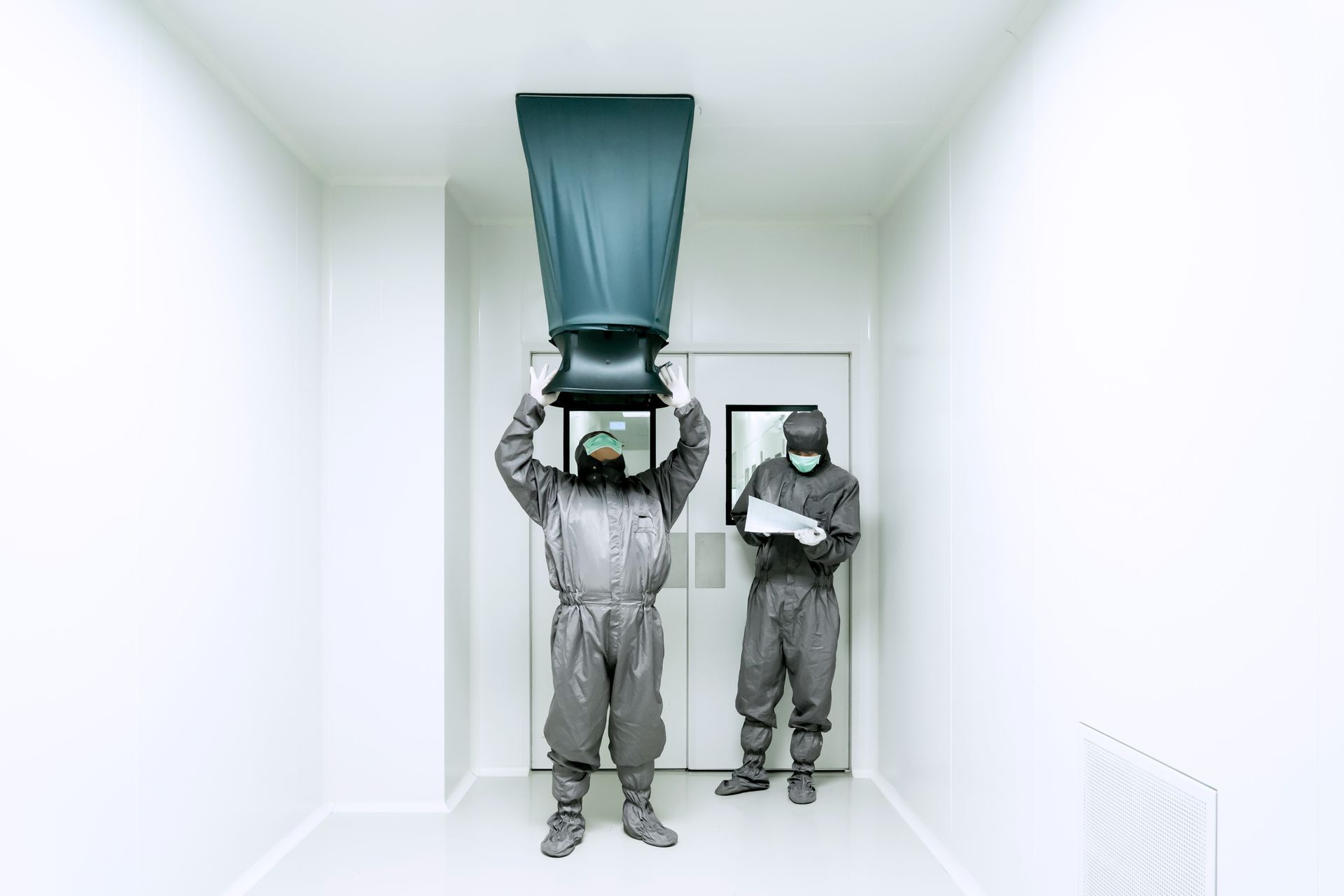
ISO 14644 and GMP environments require routine verification of filter performance.
Standard tests include:
- DOP/PAO aerosol leak testing for HEPA and ULPA filters
- Airflow velocity and uniformity tests
- Pressure-drop monitoring
- Airflow visualization (smoke studies) for unidirectional flow areas
- Filter frame and gasket inspections for bypass risk
Integrity testing ensures filters are correctly installed, free of leaks, and performing to specification.
11 Maintenance, Monitoring, and Replacement Strategies
Filter performance degrades over time due to particle loading, humidity, or chemical interactions.
Effective programs include:
- Defined pressure-drop limits for filter replacement.
- Routine visual inspections of gaskets, frames, and housings.
- Scheduled integrity testing based on classification and regulatory requirements.
- Monitoring through building management systems (BMS) for early detection of performance loss.
- Documented preventive maintenance integrated into the cleanroom’s quality system.
Proactive maintenance reduces energy consumption, prevents contamination events, and extends equipment life.
12 Energy Efficiency Considerations
Filtration represents a significant contributor to HVAC energy use.
Efficiency can be improved through:
- Low-resistance HEPA/ULPA media
- Variable-speed FFUs
- Right-sized filter stages aligned with actual contamination loads
- Optimized airflow setpoints driven by real-time monitoring
- High-performance pre-filtration to reduce HEPA loading
Modern designs prioritize energy savings without sacrificing cleanliness or compliance.
13 Best Practices for Cleanroom Filtration System Design
A high-performing cleanroom filtration system integrates:
- A well-sequenced filtration train (pre-filter → intermediate filter → HEPA/ULPA).
- Proper airflow modeling and balancing.
- Regular integrity testing and performance audits.
- Material compatibility evaluations for process chemicals or humidity.
- Clear documentation and change control for filter replacements or system modifications.
- Integration with contamination control strategies and environmental monitoring plans.
Holistic design ensures reliable cleanroom performance and simplified long-term operation.
14 Conclusion
Advanced filtration technologies are essential for maintaining cleanroom air quality, supporting contamination control, and ensuring compliance with ISO 14644 and GMP expectations. From HEPA and ULPA filters to FFUs, molecular filtration, and modern media innovations, effective filter design and maintenance are critical to the stability and performance of cleanroom environments.
By combining engineered airflow, validated filtration stages, and ongoing monitoring, cleanrooms can maintain predictable air quality, minimize contamination risks, and support high-precision manufacturing and research operations.
Read more here: About Cleanrooms: The ultimate Guide