Cleanroom – Complete Guide to Cleanroom Design, Classification, Technology and Operation

Cleanroom – Complete Guide to Cleanroom Design, Classification, Technology and Operation
A cleanroom is a controlled environment designed to maintain extremely low levels of airborne particles, microorganisms and contamination. Cleanrooms are used in industries where even microscopic contamination can affect product quality, safety or reliability. Typical industries include pharmaceutical manufacturing, semiconductor fabrication, medical device production, biotechnology and nanotechnology.
The definition of a cleanroom according to international standards such as ISO 14644 is a room in which the concentration of airborne particles is controlled and classified, and which is constructed and operated to minimize the introduction, generation and retention of contaminants.
A modern cleanroom is therefore not only a physical room but a complete system integrating cleanroom design, HVAC engineering, filtration technology, environmental monitoring, operator procedures and validation protocols.
What is a Cleanroom?
The term cleanroom (sometimes written as clean room) refers to a controlled environment where the number of airborne particles is strictly limited and monitored.
Cleanrooms are essential for processes such as:
- Semiconductor wafer fabrication
- Pharmaceutical sterile production
- Medical device manufacturing
- Microelectronics assembly
- Nanotechnology research
- Aerospace component manufacturing
Cleanrooms can be implemented as cleanroom labs, cleanroom production areas, cleanroom assembly lines or research facilities, depending on the application.
Cleanroom Classification – ISO Classes and GMP Grades
Cleanrooms are categorized according to the number and size of particles allowed in the air. The most widely used system is the ISO cleanroom classification defined in ISO 14644.
Typical ISO classes include:
ISO Cleanroom Class Typical Application
ISO Class 5 Semiconductor fabrication, sterile filling
ISO Class 6 Microelectronics assembly
ISO Class 7 Pharmaceutical manufacturing
ISO Class 8 Medical devices, clean manufacturing
Examples often referenced include cleanroom ISO 5, cleanroom ISO 6, cleanroom ISO 7 and cleanroom ISO class 8.
In the pharmaceutical industry, GMP cleanroom grades are also used:
- Cleanroom Grade A
- Cleanroom Grade B
- Cleanroom Grade C
- Cleanroom Grade D
Understanding cleanroom classifications and ISO vs GMP grades is essential when designing compliant facilities.
Cleanroom Design and Construction
Successful cleanroom facilities begin with professional cleanroom design guidelines and cleanroom design standards.
Cleanroom design typically considers:
- Cleanroom layout and zoning
- Cleanroom airflow patterns
- Pressure cascades
- Cleanroom materials and surfaces
- Personnel and material flow
- Contamination control strategy
Key construction components include:
- Cleanroom wall panels
- Cleanroom ceilings and walkable ceiling grids
- Cleanroom doors and door seals
- Cleanroom windows
- Cleanroom pass boxes and pass-through systems
- Cleanroom flooring or vinyl flooring
- Cleanroom lighting systems
Many modern facilities use modular cleanroom systems, which allow fast installation and future expansion.
Professional cleanroom builders and cleanroom manufacturers integrate architecture, HVAC systems and contamination control requirements during construction.
Cleanroom HVAC Systems, Airflow and Filtration
Air quality control is the core of cleanroom engineering.
A properly designed cleanroom HVAC system controls:
- Airflow patterns
- Air changes per hour (ACH)
- Temperature
- Humidity
- Differential pressure
- Particle filtration
Air is filtered through HEPA filters or ULPA filters, capable of removing particles as small as 0.3 microns.
Important airflow technologies include:
- Laminar airflow systems
- Turbulent airflow systems
- Cleanroom air showers
- Cleanroom air shower tunnels
Typical cleanroom air change rates range from 20 to more than 600 air changes per hour depending on the required cleanroom class.
Correct cleanroom airflow design ensures that contaminants are continuously removed from the controlled environment.
Cleanroom Equipment and Furniture
Cleanrooms require specialized equipment designed to minimize particle generation.
Typical cleanroom equipment and furniture include:
- Cleanroom benches and workstations
- Cleanroom chairs and stools
- Cleanroom carts and trolleys
- Cleanroom tables and cabinets
- Cleanroom computers and keyboards
- Cleanroom printers and label printers
In advanced manufacturing facilities such as semiconductor fabs, cleanroom automation systems are used including:
- Cleanroom robots
- AMR and AGV transport systems
- Automated wafer handling equipment
Cleanrooms may also contain specialized devices such as cleanroom ovens, wet benches, refrigerators and testing equipment.
Cleanroom Garments and Operator Apparel
Personnel are the largest source of contamination in any cleanroom environment.
For this reason, strict cleanroom attire and cleanroom gowning procedures are required.
Typical cleanroom garments include:
- Cleanroom coveralls or bunny suits
- Cleanroom gowns and frocks
- Cleanroom gloves
- Cleanroom face masks
- Cleanroom beard covers
- Cleanroom booties and overshoes
- Cleanroom head covers
Specialized ESD cleanroom garments, ESD gloves and ESD shoes are used in electronics manufacturing.
Cleanroom personnel must also follow strict cleanroom behavior rules to reduce contamination risks.
Cleanroom Supplies and Consumables
Daily cleanroom operations require a wide range of specialized consumables.
Typical cleanroom supplies include:
- Cleanroom wipes and lint-free wipes
- Cleanroom swabs and foam swabs
- Cleanroom paper and notebooks
- Cleanroom pens and markers
- Cleanroom sticky mats
- Cleanroom bags and zip bags
- Cleanroom gloves and shoe covers
Consumables must be manufactured and packaged to prevent particle release.
Cleanroom Cleaning Procedures and Hygiene
Cleanroom contamination control depends heavily on proper cleaning procedures.
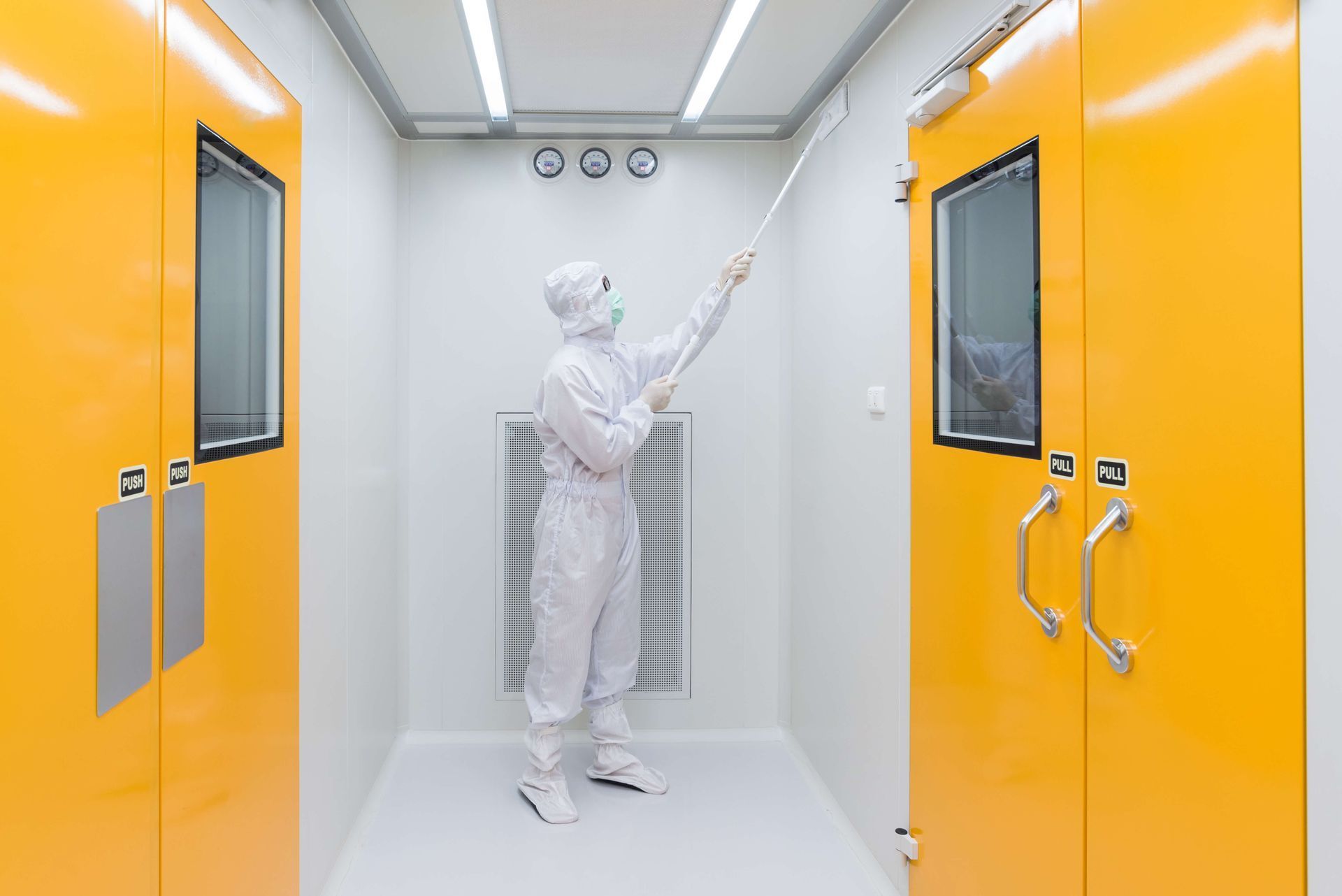
Typical cleanroom cleaning systems include:
- Cleanroom mop systems and microfiber mops
- HEPA vacuum cleaners
- Cleanroom disinfectants
- Specialized cleaning agents
Strict cleanroom cleaning procedures are implemented to ensure consistent hygiene standards.
Regular cleaning schedules and documented procedures are required in pharmaceutical and GMP cleanrooms.
Cleanroom Environmental Monitoring
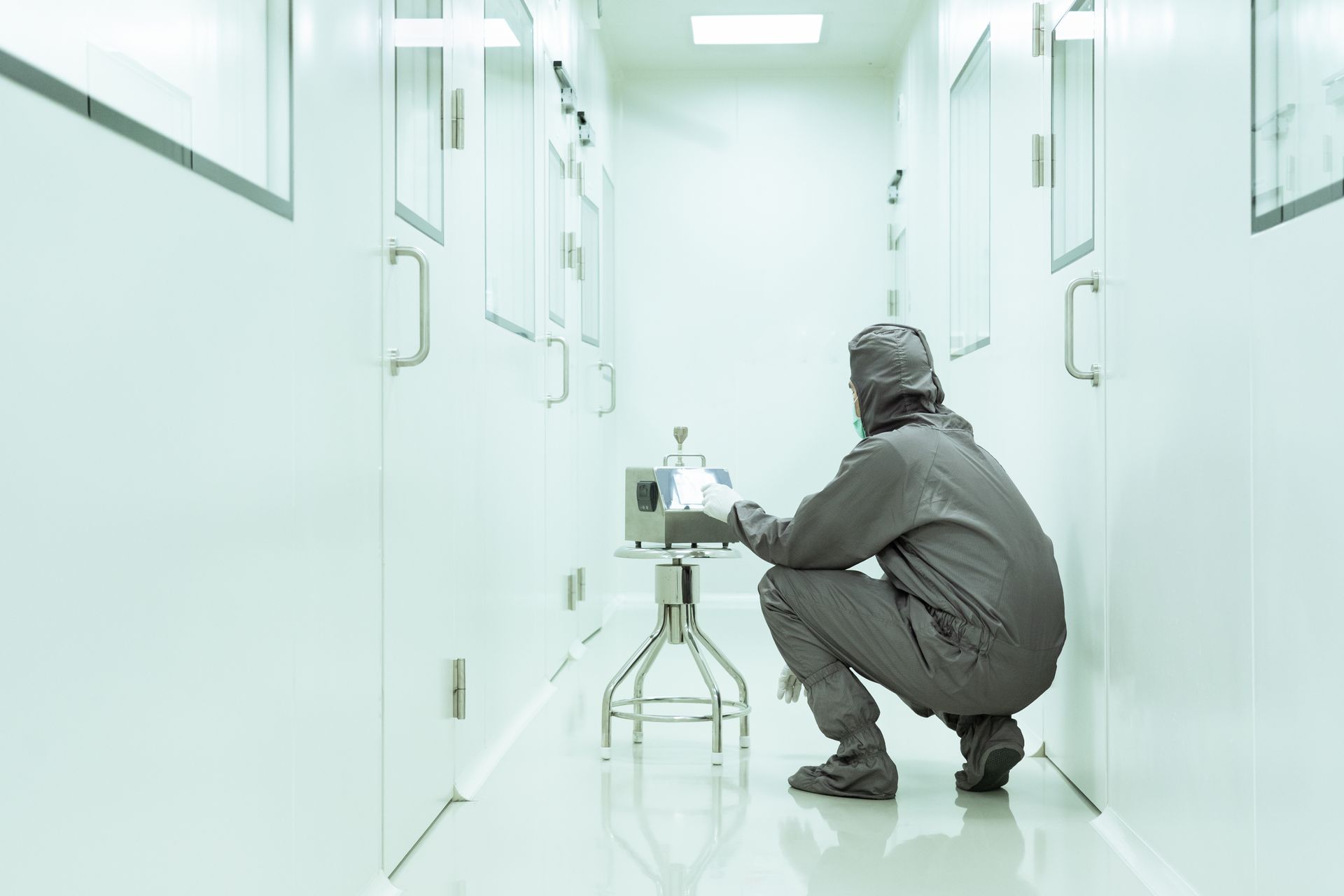
To maintain cleanroom performance, environmental monitoring systems continuously measure critical parameters.
Typical monitoring includes:
- Particle counts using cleanroom particle counters
- Microbiological monitoring
- Temperature and humidity monitoring
- Differential pressure monitoring
- Airflow velocity measurement
This cleanroom data ensures that facilities remain compliant with ISO and GMP requirements.
Cleanroom Qualification and Validation
Before a cleanroom can be used for production, it must undergo cleanroom qualification and validation.
Qualification activities include:
- Installation Qualification (IQ)
- Operational Qualification (OQ)
- Performance Qualification (PQ)
Common cleanroom qualification tests include:
- HEPA filter integrity testing
- Particle count testing
- Airflow visualization
- Recovery testing
- Pressure cascade testing
Cleanroom validation confirms compliance with ISO standards, GMP guidelines and regulatory requirements.
Cleanroom Applications and Industries
Cleanrooms are essential in many advanced industries.
Key sectors include:
Pharmaceutical Cleanrooms
Used for sterile drug production, vaccine manufacturing and biotechnology processes.
Semiconductor Cleanrooms
Used for wafer fabrication and nanotechnology.
Medical Device Cleanrooms
Used for manufacturing implants and sterile devices.
Aerospace and Optics
Used for high precision component manufacturing.
Research and Nanotechnology
Used in universities and research laboratories.
The Future of Cleanroom Technology
Cleanroom technology continues to evolve through automation, digital monitoring and energy efficient engineering.
Key trends include:
- Robotics and automated transport systems
- AI-based environmental monitoring
- Smart cleanroom HVAC systems
- Energy-efficient cleanroom design
- Modular cleanroom construction
These innovations allow cleanroom facilities to achieve higher performance while reducing operational costs.
Conclusion
A cleanroom is a highly controlled environment designed to protect sensitive processes and products from contamination.
By combining cleanroom design, HVAC engineering, filtration systems, specialized equipment, strict operator procedures and comprehensive validation, cleanrooms ensure reliable production and regulatory compliance across many high-tech industries.
As technology advances, cleanrooms will continue to play a critical role in industries such as pharmaceutical manufacturing, semiconductor fabrication and advanced scientific research.
Read more: About Cleanrooms: The Ultimate Guide