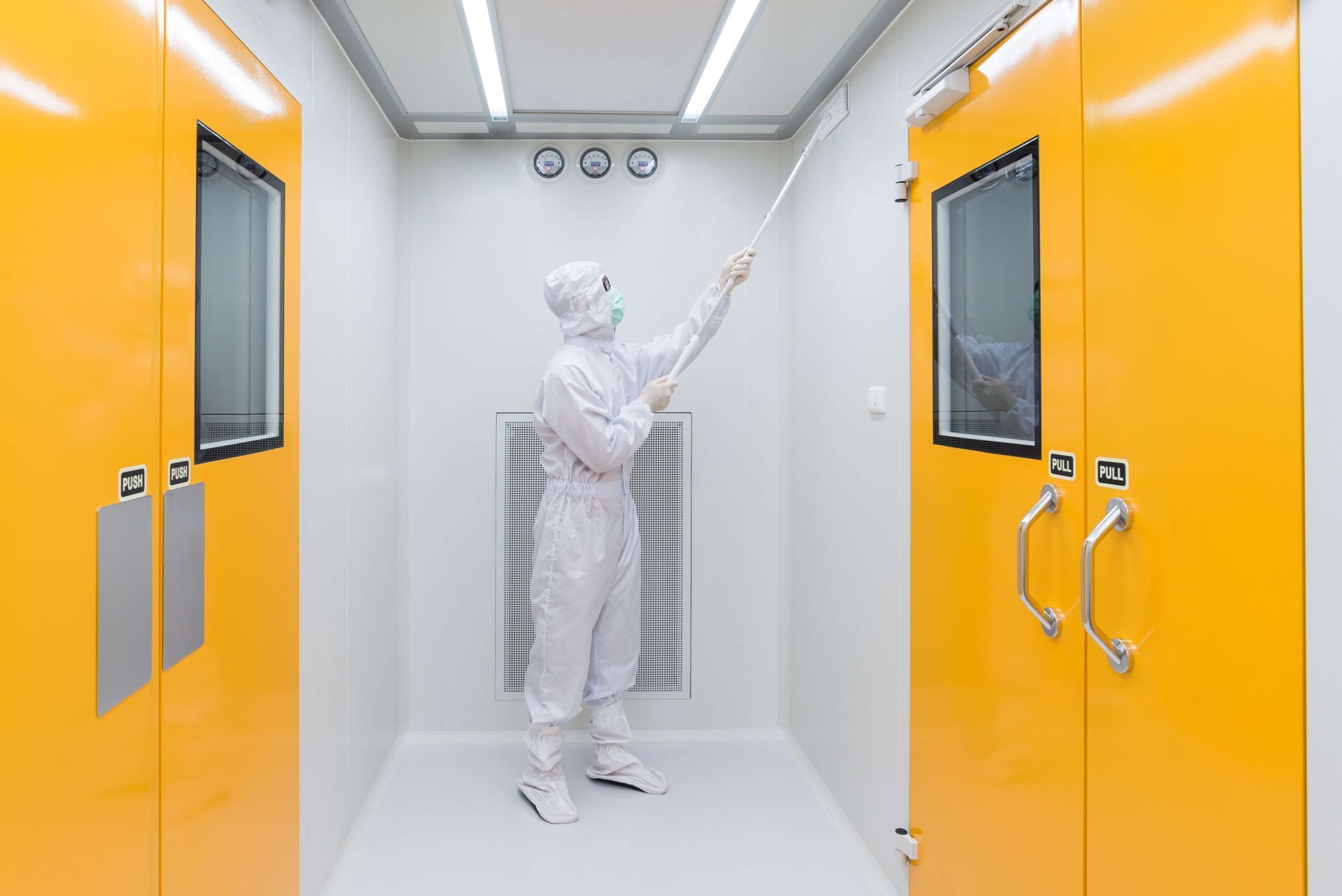
Evaluating Cleanroom Doors: Leakage, Durability, and Control Logic
How to specify and verify door systems that maintain segregation throughout their operating life
1.1 Introduction
Cleanroom doors connect spaces that must remain functionally separated. Every opening changes airflow, allows personnel or materials to cross a boundary, and temporarily challenges environmental control. When closed, the door becomes part of the room envelope and influences the airflow balance needed to maintain pressure.
Selecting a door therefore requires more than choosing a smooth panel and an interlock. Leakage, mechanical durability, cleaning compatibility, and control logic must work together. A door that seals well initially but deteriorates rapidly, or closes reliably but releases the opposite airlock door prematurely, can undermine an otherwise sound facility.
1.2 Define Performance Before Selecting Hardware
Start with the user requirements specification: room classifications, pressure relationships, contamination hazards, traffic frequency, clear opening dimensions, and transfer methods. Include trolley sizes, accessibility, emergency escape, and maintenance access.
ISO 14644-4:2022 addresses the development of cleanrooms from requirements through design, construction, and start-up. Door selection belongs within that integrated process, alongside HVAC and operational planning.
Distinguish product protection from hazardous-material containment. These objectives may require different pressure arrangements and failure responses. Translate the intended function into measurable acceptance criteria rather than requesting an undefined “airtight cleanroom door.”
1.3 Understand What Door Leakage Means
Closed-door leakage occurs through perimeter seals, thresholds, meeting stiles, hardware penetrations, and the frame-to-wall interface. Its significance depends on pressure difference and airflow direction.
Some facilities deliberately accommodate airflow through door gaps as part of the pressure cascade. Others require tighter assemblies and dedicated transfer-air paths. Neither arrangement should be accidental: the HVAC balance must account for the selected configuration.
Do not compare leakage figures without checking test pressure, door dimensions, airflow units, sealing configuration, and whether results cover the complete assembly. A value measured at one pressure cannot automatically represent performance at another. Request a leakage curve or test points covering the relevant operating range.
1.4 Verify Leakage After Installation
Factory evidence helps evaluate a design, but installed performance also depends on frame alignment, floor tolerances, wall sealing, and hardware adjustment.
Where leakage is critical, define an installed test method that isolates the intended boundary and measures airflow at specified pressure differences. Record instrument accuracy, background leakage, door condition, and acceptance limits. Whole-room leakage testing can assess the envelope, but does not identify an individual door’s contribution without additional isolation.
Airflow visualisation can reveal local flow direction and leakage paths; it does not quantify leakage volume. Likewise, achieving room pressure does not prove a door meets its leakage specification, because additional supply air may compensate for excessive leakage.
1.5 Assess Open-Door Behaviour
Closed-door results cannot predict contamination transfer during passage. Door movement, people, trolleys, temperature differences, and ventilation response can all influence airflow through an open doorway.
Evaluate representative operating sequences, including the largest routine load and realistic opening durations. Use airflow visualisation where appropriate, supported by pressure trends and recovery measurements.
Separate pressure recovery from cleanliness recovery. Pressure may stabilise before airborne contamination returns to acceptable conditions.
Where an airlock requires a release delay, establish its basis through qualification under representative conditions. A convenient timer setting alone does not demonstrate effective segregation.
1.6 Evaluate Durability and Cleanability Together
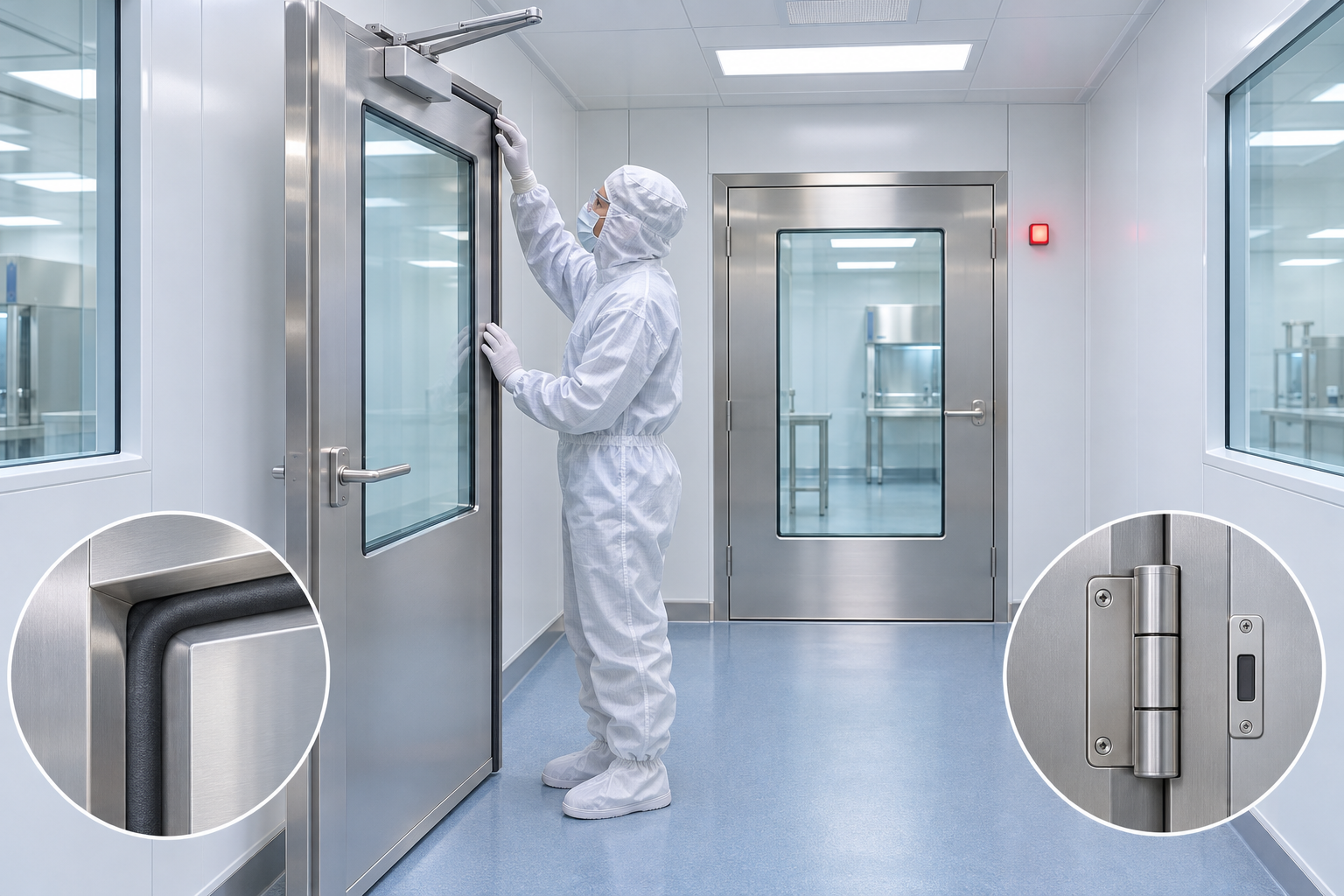
Assess hinges, closers, latches, guides, seals, glazing, and protective finishes as one assembly. Frequent cycling can loosen fixings, alter alignment, damage seals, and increase rubbing or particle generation.
Request endurance evidence relevant to the proposed door size, weight, hardware, and usage. Consider whether leakage and closing performance remain acceptable after cycling, rather than assessing cycle count alone.
EU GMP Annex 1 calls for cleanable surfaces, avoidance of inaccessible door recesses, and materials compatible with repeated cleaning and disinfection. It identifies sliding doors as potentially undesirable because of cleaning difficulties.
Evaluate actual track and enclosure details instead of assuming every sliding system has equivalent hygiene performance.
1.7 Specify Chemical Compatibility
Compatibility must cover the complete cleaning regime: chemicals, concentrations, contact times, application methods, and frequency. Include sporicidal agents or gaseous decontamination where applicable.
Examine seals, adhesives, coatings, glazing joints, and exposed hardware. Stainless steel cladding alone does not establish compatibility of the complete door.
Look for documented resistance to swelling, embrittlement, corrosion, delamination, and loss of seal compression. Practical maintenance matters equally: seals should be inspectable and replaceable, and servicing should minimise contamination of adjacent controlled areas. Define cleaning and verification steps before returning the door to service.
1.8 Develop Explicit Interlock Logic
An airlock interlock must coordinate access according to a documented sequence. Define request handling, door-position confirmation, locking feedback where required, release conditions, and abnormal states.
Annex 1 paragraph 4.13 states that airlock and pass-through entry and exit doors should not open simultaneously. It specifies interlocking for airlocks leading to Grade A and B, and at least visual and/or audible warnings for those leading to Grade C and D. Delays should be established where needed to maintain segregation.
For other applications, select controls through the relevant risk assessment. A closed-position switch does not necessarily prove latch engagement, seal compression, or acceptable pressure.
1.9 Define Faults and Emergency Responses
Develop a cause-and-effect matrix covering simultaneous requests, prolonged opening, failed position sensors, lock faults, power interruption, controller restart, and ventilation failure.
Specify which conditions inhibit routine access, generate alarms, require acknowledgement, or demand an operator response. If pressure forms part of the release logic, define sensor validity, thresholds, stability periods, and behaviour following signal loss.
Coordinate emergency release with the applicable fire strategy and escape requirements. “Fail safe” must describe a defined outcome for each relevant scenario. Emergency operation should also trigger an appropriate contamination assessment before normal activities resume.
1.10 Qualify the Complete Door System
Installation checks should confirm approved components, frame sealing, alignment, wiring, sensor identification, and controlled software settings.
Operational testing should challenge normal sequences and credible faults. Include obstructed closure, emergency release, power restoration, and interfaces with access control, ventilation, and building monitoring systems.
Then demonstrate performance under representative use. A successful empty-airlock test may not represent a trolley transfer or repeated personnel passage. Acceptance should connect mechanical operation, leakage, airflow behaviour, alarms, and recovery to the original requirements. Record deviations and corrections before releasing the system.
1.11 Maintain Performance Through Trending
Set maintenance intervals using operating frequency, environmental exposure, manufacturer guidance, and observed deterioration. Inspect seal condition, alignment, closing action, thresholds, and sensor operation.
Trend prolonged-opening alarms, failed closures, interlock faults, and pressure recovery. Repeated adjustments can indicate an underlying mechanical problem rather than isolated maintenance needs.
Control changes to seals, closers, software, and timing settings. Assess whether each change requires targeted functional testing or wider requalification.
1.12 Conclusion
A cleanroom door is a mechanical barrier, an airflow boundary, and a controlled transfer point. Its performance depends on the complete installed assembly and the way people use it.
Define measurable requirements, verify leakage under relevant conditions, assess durability and chemical resistance, and challenge control logic through normal and abnormal operation. This provides a defensible basis for maintaining segregation throughout the door’s service life.
Sources
ISO 14644-4:2022, Cleanrooms and associated controlled environments — Part 4: Design, construction and start-up. https://www.iso.org/standard/72379.html
European Commission, EU GMP Annex 1: Manufacture of Sterile Medicinal Products (2022), paragraphs 4.5–4.7 and 4.12–4.16. https://health.ec.europa.eu/system/files/2022-08/20220825_gmp-an1_en_0.pdf
The practical specification and testing recommendations above are engineering guidance; project-specific acceptance limits must reflect the application and risk assessment.