The Role of Cleanrooms in Aerospace Manufacturing

Kjeld Lund January 17, 2025
14644 Cleanroom in Defence Drone Industry

Introduction


Cleanrooms play a crucial role in the aerospace industry, where precision, reliability, and compliance with stringent standards are paramount. From satellite assembly to the production of aircraft components and space exploration vehicles, maintaining a contaminant-free environment is vital to ensure the performance and safety of aerospace products. This article delves deeply into the role of cleanrooms in aerospace manufacturing, examining the specifications, technologies, and processes involved, as well as the challenges and advancements shaping this critical aspect of aerospace engineering.


Introduction to Cleanrooms in Aerospace Manufacturing


Cleanrooms are controlled environments with low levels of pollutants such as dust, airborne microbes, and aerosol particles. In aerospace manufacturing, these facilities are designed to control particulate contamination and ensure that the environment does not adversely affect the products being manufactured. The importance of cleanrooms in this sector cannot be overstated, given the catastrophic consequences that contamination could cause in aerospace applications.


Specifications and Standards


The aerospace industry adheres to stringent cleanroom standards, primarily governed by ISO 14644 and IEST standards for cleanrooms. The ISO 14644 series specifies cleanroom air cleanliness in terms of the number of particles per cubic meter at specified particle size. The required class of cleanroom varies depending on the particular aerospace application. For instance, manufacturing of spacecraft components typically requires ISO Class 5 or better, which allows no more than 3,520 particles (0.5 microns or larger) per cubic meter.


In addition to ISO standards, aerospace manufacturers must also comply with specific industry standards such as those from NASA and the Department of Defense, which may have unique requirements for particular projects or components.


Key Applications of Cleanrooms in Aerospace Manufacturing


1. Satellite Assembly:  The assembly and testing of satellites require highly controlled environments to prevent the contamination of sensitive onboard electronics and optical components. Even microscopic particles can cause failure of sensors and circuits, which is unacceptable in space missions.


2. Aircraft Component Manufacturing:  High-precision components such as turbine blades and avionics are manufactured in cleanrooms. Contamination in these components can lead to inefficiencies, increased fuel consumption, or catastrophic failures.


3. Space Exploration Vehicles:  Cleanrooms are essential for the assembly of space exploration vehicles, including rovers and spacecraft. These vehicles operate in extreme conditions where any failure could jeopardize the entire mission and lead to significant financial losses.

Technologies and Equipment


The effectiveness of cleanrooms in aerospace manufacturing hinges on several key technologies and pieces of equipment:


  • HEPA and ULPA Filters: These filtration systems are capable of trapping 99.97% to 99.9995% of particles, respectively, providing the necessary air purity for sensitive manufacturing processes.
  • Air Showers and Pass-Through Chambers: Used to minimize contamination when personnel or materials enter the cleanroom.
  • Temperature and Humidity Control Systems: Precise control over temperature and humidity is crucial to prevent static build-up and condensation, which can damage sensitive aerospace components.
  • Laminar Air Flow Systems: These systems direct filtered air in a constant stream, reducing the chance of turbulent air that can stir up particles.


Challenges in Aerospace Cleanroom Management


1. Maintaining Stringent Contamination Control:  Continuous monitoring and maintenance are required to ensure that cleanrooms remain within the required specifications for particle counts, air purity, and environmental conditions.


2. High Operational Costs:  Operating a cleanroom is expensive due to the energy costs of air handling systems and the need for specialized maintenance of filtration and HVAC systems.


3. Technological Advancements:  Keeping up with advances in aerospace technology often requires upgrades to cleanroom facilities to handle new materials or components that have higher sensitivity to contaminants.


Future Trends and Innovations


The future of cleanrooms in aerospace manufacturing is likely to see several innovations:


  • Automation and Robotics: To reduce human error and further minimize contamination, more processes within cleanrooms are expected to be automated or handled by robots.
  • Advanced Materials: The development of new materials that are less prone to shedding particles or attracting contaminants could reduce the need for stringent cleanroom conditions.
  • Real-Time Monitoring Technologies: Enhanced sensors and IoT technologies are expected to provide real-time data on cleanroom conditions, allowing for immediate adjustments and predictive maintenance.


Conclusion


Cleanrooms are indispensable in aerospace manufacturing, providing the necessary controlled environment to manufacture highly reliable and high-performance aerospace components. As the aerospace industry continues to push the boundaries of technology and exploration, the role of cleanrooms will only grow in importance, driven by advancements in cleanroom technologies and practices.


Adhering to strict cleanroom standards and continually evolving with technological advancements ensures that aerospace products are manufactured with the highest reliability, supporting the overall safety and success of aerospace missions.


Read more:  All About Cleanrooms - The ultimate Guide

Scientist in blue gloves examining test tubes in a lab, with a DNA strand overlay.
By Kjeld Lund 30 January, 2026 January 29, 2026
Lifecycle Qualification Strategies for Modern Cleanrooms (DQ–IQ–OQ–PQ) 1. Introduction Lifecycle qualification is a foundational framework for ensuring that modern cleanrooms consistently meet the performance, compliance, and product-protection requirements defined by ISO 14644 , GMP Annex 1 , and related regulatory expectations. The DQ–IQ–OQ–PQ sequence provides a structured, evidence-driven method to verify that a cleanroom is designed correctly, installed correctly, operating correctly, and performing consistently under real process conditions. This article outlines practical, engineering-grounded lifecycle qualification strategies suitable for new cleanroom facilities, major retrofits, and ongoing performance lifecycle management. 2. Design Qualification (DQ) Design Qualification establishes that the cleanroom design—down to the HVAC architecture, building envelope, process layout, and control strategies—meets the intended functional, regulatory, and risk-reduction requirements. DQ must be fully documented and approved prior to procurement or construction. Key Objectives Demonstrate alignment with user requirements (URS), regulatory standards, and contamination-control risk assessments. Validate the design basis for airflow volume, pressure regime, filtration efficiency, heat loads, and classification goals. Confirm that materials, finishes, and mechanical/electrical systems support cleanability, durability, and cleanroom compatibility. Core Activities URS Development: Defines required cleanliness class (e.g., ISO 7/8 rooms leading to ISO 5 zones), environmental parameters, process flows, and gowning strategy. Basis of Design (BOD) Review: Verifies engineering assumptions including supply air volume, terminal HEPA load, air change rate targets, and pressure cascade. Design Risk Assessment: Evaluates contamination pathways, personnel/material movement, and failure modes (e.g., loss of differential pressure). Drawings and Specification Review: Architectural drawings, HVAC schematics, control diagrams, and finish schedules are checked against URS and applicable standards. DQ Acceptance Criteria All functional requirements traceable to the URS. Design conforms to ISO 14644 requirements, GMP zoning concepts, and classified-area pressure cascade norms. Design risks identified and mitigated with engineering or procedural controls. 3. Installation Qualification (IQ) Installation Qualification verifies that the cleanroom and its systems were installed according to approved design documentation and equipment specifications. IQ is typically executed after construction is complete but prior to HVAC balancing and environmental verification. Key Objectives Confirm correct installation of architectural elements, HVAC components, filtration assemblies, electrical systems, and monitoring devices. Verify that materials and finishes meet certification requirements (e.g., low-VOC, non-shedding, GMP-compatible). Document all utilities, equipment IDs, calibration statuses, and as-built conditions. Core Activities Component Verification: HEPA/ULPA filters, fan filter units (FFUs), terminal housings, ductwork, dampers, valves, and sensors must match approved specifications. Material and Finish Inspection: Wall panels, flooring, doors, pass-throughs, and sealants are checked for fit, compatibility, cleanability, and integrity. As-Built Documentation: Includes redlined drawings, HVAC equipment lists, control sequences, and wiring diagrams. Calibration and Utilities Check: Differential pressure sensors, temperature/humidity probes, and airflow measurement devices are installed, tagged, and calibrated. IQ Acceptance Criteria All equipment installed per manufacturer recommendations and design documents. All sensors and instruments calibrated with traceability. As-built documentation complete and approved. 4. Operational Qualification (OQ) Operational Qualification demonstrates that the cleanroom and its supporting HVAC/control systems operate as designed across the full range of expected environmental and operating conditions. OQ is executed after HVAC commissioning and initial balancing but before introducing process equipment or personnel workflows. Key Objectives Confirm the HVAC system achieves and maintains the required environmental conditions (classification, pressure, temperature, humidity). Demonstrate correct operation of interlocks, alarms, monitoring systems, and control loops. Verify that control logic supports contamination-control requirements, including recovery and cascade stability. Core Activities Airflow and Pressure Verification: Measurement of supply volume, extract volume, and differential pressures between adjacent zones under at-rest conditions. HEPA Integrity Testing: Leak testing using ISO 14644-3 compliant methods (e.g., PAO/DEHS aerosol challenge). Particle Classification Testing: Conduct at-rest classification tests per ISO 14644-1 to confirm compliance with specified cleanroom class. Recovery Testing: Demonstrate the room’s ability to return to classification levels after a particle challenge or simulated disturbance. Alarm and Interlock Testing: Validation of door interlocks, pressure-loss alarms, temperature/humidity deviations, and exhaust/supply failures. Environmental Stability Study: Trending temperature, humidity, and pressure over time to ensure steady-state performance. OQ Acceptance Criteria All environmental parameters meet specified limits under at-rest conditions. All alarms/interlocks operate predictably and within defined tolerances. HEPA filters pass integrity tests with no leaks above allowed limits. Particle counts comply with the ISO class designation. 5. Performance Qualification (PQ) Performance Qualification confirms that the cleanroom performs as required under normal operational conditions, including personnel activity, equipment operation, and process workflows. PQ represents the final verification stage before routine production or regulated use. Key Objectives Validate real-world performance including personnel-generated loads, process equipment heat loads, and operational contamination sources. Demonstrate environmental control and consistency during typical and peak operational states. Establish baseline performance data for future ongoing monitoring. Core Activities Dynamic Classification Testing: Particle sampling during typical operations with personnel, processes, and equipment running. Microbial Monitoring: Viable air and surface sampling following GMP Annex 1 expectations. Temperature/Humidity/Pressure Trending: Confirmation that environmental parameters remain stable during active operations. Process Simulation (Media Fill or Surrogate Operations): For aseptic processes, PQ may include media fills or other simulation protocols. Workflow Verification: Assessment of gowning, personnel behavior, and material transfer methods to ensure contamination control integrity. PQ Acceptance Criteria Cleanroom meets required ISO class under operational conditions (where required by process). Microbial contamination levels remain within specified action and alert limits. Operational conditions do not compromise the pressure cascade or airflow patterns. All critical process simulations meet acceptance criteria. 6. Documentation Structure and Traceability A robust documentation package ensures regulatory compliance and facilitates future audits and requalification. Each lifecycle stage must include: Qualification protocols (DQ/IQ/OQ/PQ) with clearly defined acceptance criteria. Traceability matrices linking URS → DQ → IQ/OQ/PQ tests. Calibration records, commissioning reports, and as-built drawings. Deviations, corrective actions, and risk assessments. A final qualification summary report consolidating results and confirming readiness. 7. Integration With ISO 14644 and GMP Annex 1 Modern cleanroom qualification strategies must continuously reflect international standards and regulatory updates. ISO 14644 Part 1: Air cleanliness classification by particle concentration. Part 2: Monitoring requirements for demonstrating continued compliance. Part 3: Test methods for cleanroom performance (airflow, recovery, HEPA integrity). Part 4: Design, construction, and start-up best practices. Part 16: Energy efficiency considerations. GMP Annex 1 adds requirements for: Contamination Control Strategy (CCS). Formal risk management throughout the cleanroom lifecycle. Demonstrable environmental control during sterile operations. Expected performance and monitoring frequencies for classified areas. Qualification strategies must ensure that the DQ–IQ–OQ–PQ lifecycle aligns with every relevant element of the CCS, including airflow design, cleaning effectiveness, gowning, and monitoring programs. 8. Requalification and Ongoing Lifecycle Management Qualification does not end with PQ. Cleanrooms require periodic requalification, especially HEPA integrity, airflow verification, and environmental monitoring performance assessments. Typical requalification intervals: HEPA integrity: annually (or more often for high-risk areas). Airflow/pressure/temperature/humidity: semiannual to annual, depending on risk. ISO classification tests: typically annual for high-grade areas; up to biennial for lower-risk rooms, based on documented risk justification. Changes in configuration, HVAC equipment, control logic, or process flows should trigger change control and potentially partial requalification. 9. Conclusion Effective lifecycle qualification using the DQ–IQ–OQ–PQ framework is fundamental for ensuring that modern cleanrooms are engineered, constructed, and operated to meet rigorous contamination-control requirements. A disciplined approach grounded in ISO 14644, GMP Annex 1, and established engineering practice produces cleanrooms that operate with reliability, safety, and regulatory confidence. By maintaining robust documentation, integrating risk management, and committing to ongoing monitoring and requalification, facility owners and operators can ensure long-term cleanroom performance and compliance. Read more here: About Cleanrooms: The ultimate Guide
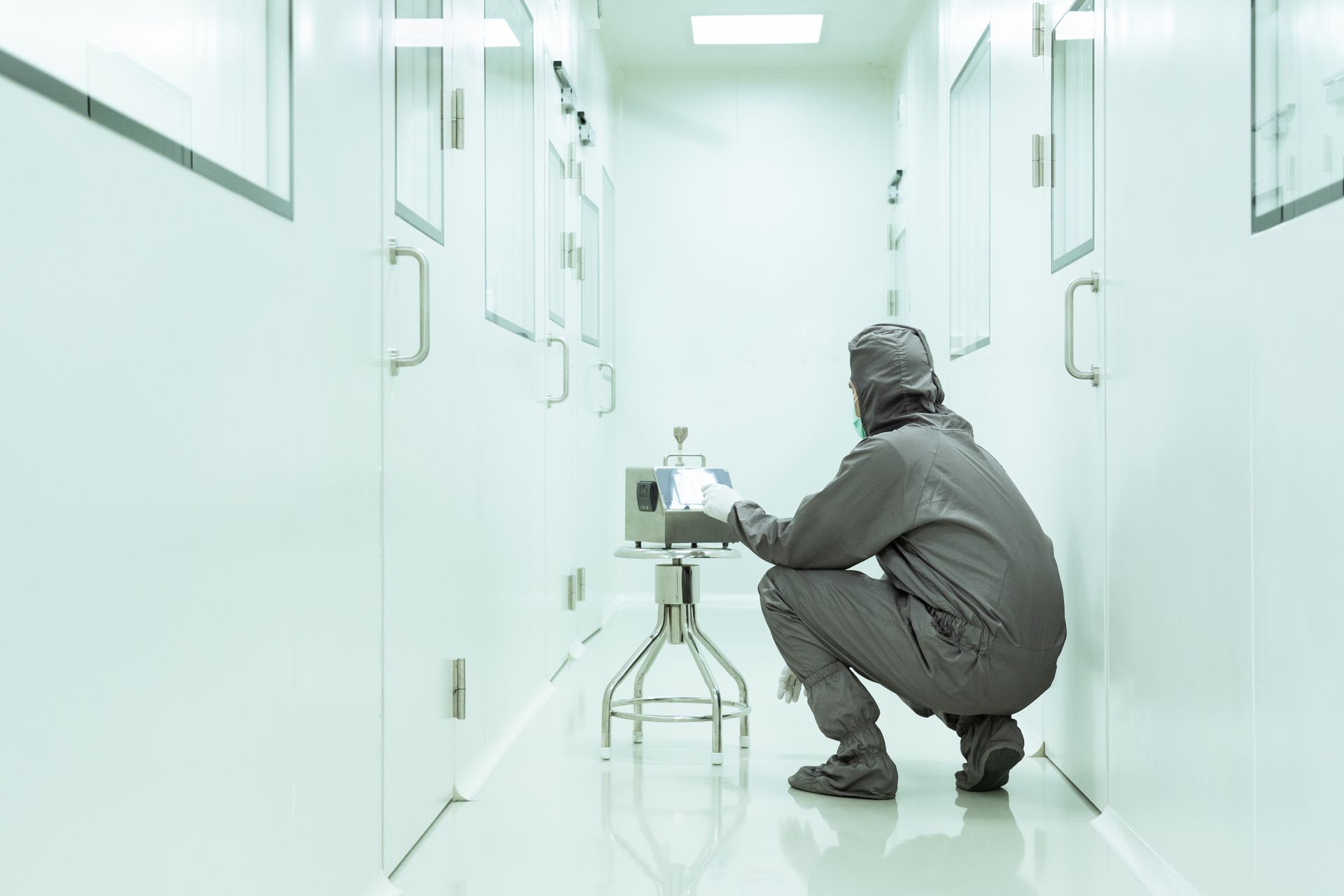
Person in protective suit crouches near equipment in a sterile white hallway.
By Kjeld Lund January 23, 2026 January 22, 2026
Cleanroom Audit and Compliance Checklist 1 Introduction A structured cleanroom audit is essential for verifying compliance with ISO 14644, GMP guidelines, and internal quality standards. Routine audits help identify deviations, ensure consistent contamination-control practices, and maintain readiness for regulatory inspections. A comprehensive checklist provides a systematic framework for evaluating design integrity, operational performance, documentation, training, and ongoing environmental control. This article presents a detailed checklist that organizations can use to assess cleanroom compliance and strengthen their quality systems. 2 Facility Design and Structural Integrity Audits should begin with verification of physical cleanroom features that influence cleanliness, containment, and maintainability. Key points include: Smooth, cleanable wall, floor, and ceiling finishes Intact seals around penetrations, doors, utilities, and windows Adequate lighting and properly sealed fixtures Flush-mounted hardware to prevent particle accumulation Verified material compatibility with cleaning agents Condition of airlocks, pass-throughs, and gowning rooms Correct zoning and separation of clean and unclean pathways Document findings related to damage, wear, or integrity concerns that may compromise contamination control. 3 HVAC and Airflow Performance The HVAC system is the core of cleanroom classification and stability. Audits must evaluate whether systems operate within validated parameters. Checklist items include: Air change rates consistent with ISO classification and design specifications Correct pressure cascades between adjacent rooms HEPA/ULPA filter integrity testing data (e.g., DOP/PAO results) Airflow direction and uniformity, verified through recent testing Temperature and humidity within defined limits Vibration or noise issues affecting airflow stability Maintenance and calibration records for HVAC controls and sensors Any deviation in airflow performance should trigger further investigation into system balancing or filter loading. 4 Environmental Monitoring Program Auditors must verify that environmental monitoring (EM) is executed according to approved procedures and risk-based sampling plans. Key audit checks: Approved EM plan covering viable and nonviable monitoring Defined sampling locations and frequencies Documented alert/action limits aligned with classification Calibration records for particle counters and microbiological equipment Trend reports demonstrating ongoing analysis of data Corrective actions documented for any excursions Qualification records for sampling personnel EM programs must be regularly reviewed and updated based on historical data and process changes. 5 Cleaning and Disinfection Controls Cleaning and disinfection routines ensure the cleanroom maintains consistent cleanliness levels. The audit should confirm both procedural compliance and record accuracy. Checklist items: Current SOPs for cleaning frequency, agents, and methods Verified disinfectant rotation schedules Logs with complete operator signatures, timestamps, and agent lot numbers Evidence that correct contact times are achieved Storage and expiration control for cleaning agents Validation or qualification data for new agents or methods Inspect actual cleaning tools and carts to confirm they meet defined specifications. 6 Gowning, Behavior, and Personnel Practices Human operators are a major contamination source. Audits must confirm that personnel follow approved procedures and maintain proper hygiene and conduct. Verification points: Approved gowning SOPs with clear donning/doffing sequences Compliance with garment integrity requirements Proper use of gloves, masks, and other PPE Behavior standards: no unnecessary movement, no personal items, controlled communication Training records demonstrating competence in gowning procedures Observations of actual operator behavior during operations Nonconformities typically point to training gaps or insufficient procedural clarity. 7 Material, Equipment, and Tool Control Materials and equipment entering cleanrooms must follow validated preparation and transfer procedures. Audit checks include: Defined material flow paths with controlled entry/exit points Validated cleaning or sterilization procedures for reusable tools Inspection of pass-through chambers for proper function and cleanliness Calibration status for all instruments used in the cleanroom Maintenance records for process tools Labeling and identification of materials, including expiration dates Procedures preventing cross-contamination or mix-ups Improper material control often correlates with contamination excursions. 8 Documentation and Recordkeeping Auditors must examine documentation for accuracy, currency, and compliance with GMP and ISO expectations. Checklist points: Current controlled SOPs accessible at point of use Revision histories and approval signatures Completed logbooks with no gaps, overwriting, or missing entries Batch records and monitoring sheets completed contemporaneously Deviation and CAPA (Corrective and Preventive Action) documentation Document retention practices aligned with regulatory requirements Clear links between training and document revisions Documentation quality reflects the maturity of the cleanroom’s quality system. 9 Change Control and Validation Changes to processes, equipment, or environmental controls must be documented and assessed for contamination and compliance impact. Audit criteria: Defined change-control procedures and responsibilities Impact assessments addressing cleanroom classification or validation needs Updated drawings, SOPs, and training following approved changes Validation reports (IQ/OQ/PQ) for new installations or modifications Periodic review of change-control logs Lack of disciplined change control is a major audit finding in regulated industries. 10 Waste Management and Containment Appropriate waste control supports both contamination management and safety. Checklist items: Segregated waste streams (biological, chemical, general) Clearly labeled containers with proper closures Defined removal frequencies Safe handling procedures for hazardous waste Clean and organized waste staging areas Documentation of waste transfer or disposal Improper waste handling can compromise room classification and operator safety. 11 Safety Systems and Emergency Readiness Cleanroom audits must verify that safety controls function correctly and remain compliant. Audit checks include: Functionality of emergency shutoffs and alarms Availability and condition of spill-response kits Fire protection systems (sprinklers, extinguishers, alarms) Gas detection and monitoring (if applicable) Trained emergency response personnel Documented and rehearsed emergency procedures Emergency readiness protects personnel and maintains regulatory compliance. 12 Training and Competency Personnel competency must be evaluated continuously. Checklist includes: Training matrices linked to job roles and SOP numbers Records of initial training, periodic retraining, and qualification Assessments verifying operator understanding and performance Training updates in response to procedural changes Defined qualification requirements for auditors and supervisors Well-documented training prevents procedural drift and ensures consistent performance. 13 Audit Trails, CAPA, and Continuous Improvement Effective audits generate actionable insights. Auditors must verify that findings are handled systematically. Key considerations: Defined process for documenting audit findings Root-cause analysis procedures (e.g., 5-Why, fishbone diagrams) CAPA timelines, responsibilities, and effectiveness checks Trend evaluation across multiple audit cycles Periodic review of quality metrics related to cleanroom performance Continuous improvement strengthens long-term cleanroom integrity and regulatory readiness. 14 Conclusion A comprehensive audit and compliance checklist provides a structured approach for evaluating cleanroom performance, identifying gaps, and sustaining contamination control. By assessing facility design, HVAC performance, environmental monitoring, cleaning practices, personnel behavior, documentation, and emergency readiness, organizations can maintain reliable, compliant cleanroom operations aligned with ISO 14644 and GMP requirements. Routine audits not only ensure regulatory preparedness but also support continuous improvement, helping cleanrooms operate with consistency, safety, and technical excellence. Read more here: About Cleanrooms: The ultimate Guide
Robotic arm placing microchips on a circuit board, inside a manufacturing facility.
By Kjeld Lund January 16, 2026 January 15, 2026
The Global Impact of Cleanrooms on Manufacturing 1 Introduction Cleanrooms have become an essential infrastructure component across global manufacturing, enabling industries to achieve unprecedented levels of precision, reliability, and contamination control. As product tolerances shrink and regulatory expectations intensify, cleanrooms allow manufacturers to produce consistent, defect-free outputs at scale. Their influence extends far beyond traditional sectors like pharmaceuticals and semiconductors—cleanrooms now shape advancements in aerospace, biotechnology, optics, medical devices, and emerging nanotechnologies. This article examines how cleanrooms drive global manufacturing capability, quality, and innovation. 2 Cleanrooms as Enablers of High-Precision Manufacturing Cleanrooms provide the controlled environment required for products where microscopic contaminants can compromise performance, safety, or functionality. By regulating airborne particles, microorganisms, humidity, temperature, and electrostatic conditions, cleanrooms enable: Ultra-fine geometries in semiconductor devices High-purity pharmaceutical and biologic production Precision assembly of medical implants Manufacturing of defect-free optical components Reliable fabrication of aerospace and defense technologies Without controlled environments, many modern products would be impossible to manufacture consistently. 3 Growth of Cleanrooms Driven by Technological Advancement Global demand for cleanrooms has expanded alongside emerging manufacturing technologies. Key drivers include: Shrinking semiconductor nodes that require ISO 3–5 environments. Biopharmaceutical expansion , including cell and gene therapies requiring aseptic or Grade A/B conditions. Advanced materials and nanotechnology , which depend on ultra-low particulate levels. Battery and energy-storage manufacturing , where contaminants degrade product performance. Medical device miniaturization demanding tight contamination control. As industries evolve toward higher performance and tighter tolerances, cleanroom infrastructure has become increasingly indispensable. 4 Cleanrooms Supporting Global Supply Chain Reliability Manufacturers rely on cleanrooms to ensure stable, reproducible production across global facilities. Cleanroom-controlled processes reduce variability and help companies: Meet international quality standards Harmonize production across regions Reduce defect rates and waste Maintain supply chain continuity Demonstrate compliance during global audits Standardized cleanroom design and operation also support technology transfer between manufacturing sites, enabling multinational firms to scale rapidly. 5 Regulatory Influence on Cleanroom Manufacturing Many industries operate under stringent regulatory frameworks that directly dictate cleanroom use. Examples include: GMP for pharmaceuticals and biologics , requiring controlled environments for aseptic fills, sterile filtration, and packaging. ISO 14644 standards guiding classification, testing, and monitoring across most cleanroom sectors. ISO 13485 requirements for medical device manufacturing environments. Aerospace and defense standards requiring rigorous contamination-control planning. Industry-specific environmental and safety regulations affecting chemical and nano-material use. Cleanrooms help manufacturers meet these obligations and maintain globally recognized compliance certifications. 6 Impact on Product Quality and Yield Cleanrooms directly influence product yield, consistency, and performance. With controlled environments: Defects related to airborne particles are minimized. Microbial contamination risks in sterile products are reduced. Surface cleanliness remains predictable during assembly. Complex devices can be produced with higher reliability. Rework, scrap, and batch failures decrease significantly. This yields major economic benefits—higher throughput, improved efficiency, and greater customer trust. 7 Cleanrooms as Innovation Accelerators Cleanroom environments make it possible to push technical limits in research and production. Their global impact includes enabling: Development of next-generation semiconductor architectures Manufacturing of biologics and personalized medicine Precision optical coatings for space and defense Advanced robotics and sensor technologies Emerging quantum computing hardware Microelectromechanical systems (MEMS) and nanofabrication Innovation often relies on the ability to control contamination to levels that support new material science and manufacturing precision. 8 Expansion into Emerging Markets As high-tech industries globalize, cleanroom infrastructure is rapidly expanding into emerging markets. Countries investing heavily in cleanroom-enabled manufacturing include those developing: Semiconductor fabs Vaccine and biologics facilities Battery and energy-storage plants Aerospace supply chains Optical and photonics production hubs This expansion strengthens local economies, diversifies global supply chains, and increases access to advanced manufacturing technologies worldwide. 9 Economic Benefits and Workforce Development Cleanroom manufacturing generates significant economic value by: Creating high-skill technical jobs Supporting engineering, construction, and validation industries Enabling export-driven manufacturing sectors Increasing national competitiveness in high-value markets Supporting local supply chains for components, consumables, and equipment Operating a cleanroom also requires specialized training, driving development of a more technically qualified workforce. 10 Environmental and Energy Considerations Cleanrooms are energy-intensive due to high airflow rates, filtration stages, and strict environmental controls. Their global impact includes increasing emphasis on: Energy-efficient HVAC systems Low-resistance HEPA/ULPA filters Variable-speed fan filter units Optimized air change rates driven by monitoring data Sustainable construction materials Life-cycle cost analysis and predictive maintenance Modern cleanroom design increasingly balances performance with environmental responsibility. 11 Standardization and Global Consistency ISO 14644 has become the universal reference for environmental classification and testing, enabling consistent cleanroom operation worldwide. Global standardization supports: Predictable quality across international facilities Cross-border product approvals Supplier and partner alignment Harmonized training and qualification programs Uniform validation and monitoring requirements This standardization strengthens manufacturing reliability at the global scale. 12 Cleanrooms and the Future of Manufacturing Cleanrooms will play a central role in emerging technologies and next-generation production systems. Future trends likely include: Increased use of mini-environments and isolator technologies Integration of real-time monitoring and smart building controls Expansion of modular and scalable cleanroom systems Growth in high-purity material production Greater reliance on automation to reduce human contamination As industries continue to innovate, cleanrooms will remain critical infrastructure for precision manufacturing. 13 Conclusion Cleanrooms have reshaped global manufacturing by enabling ultra-clean environments that support high-precision, high-reliability production. From semiconductors and biopharmaceuticals to aerospace and nanotechnology, cleanrooms ensure product quality, regulatory compliance, and operational stability across the world. Their impact extends beyond individual facilities—cleanrooms strengthen supply chains, drive economic growth, and enable the technological advancements that define modern industry. As emerging technologies demand even tighter environmental control, cleanrooms will continue to be a cornerstone of global manufacturing excellence. Read more here: About Cleanrooms: The ultimate Guide
Show More