Investigating Turbulent vs. Unidirectional Flow in Hybrid Clean Spaces
Balancing Airflow Strategies to Optimize Contamination Control, Energy Efficiency, and Operational Performance
Investigating Turbulent vs. Unidirectional Flow in Hybrid Clean Spaces
Introduction
Hybrid cleanroom designs are becoming increasingly common in pharmaceutical, biotechnology, medical device, semiconductor, and advanced manufacturing facilities. Instead of relying exclusively on either unidirectional (formerly called laminar) airflow or turbulent mixed airflow, many modern cleanrooms combine both strategies to achieve targeted contamination control while optimizing construction and operating costs.
The selection of airflow patterns is one of the most influential decisions in cleanroom engineering. Air distribution affects particle removal, contamination control, environmental stability, operator behavior, and energy consumption.
Understanding how turbulent and unidirectional airflow interact within hybrid clean spaces enables engineers to design facilities that meet regulatory requirements while supporting efficient manufacturing processes.
1.1 Understanding Cleanroom Airflow Principles
Cleanroom ventilation systems are designed to dilute, remove, and control airborne particles generated by personnel, equipment, and manufacturing activities.
Two primary airflow strategies are used:
- Unidirectional airflow
- Turbulent mixed airflow
Each serves different contamination control objectives and is selected based on process criticality rather than facility type alone.
The objective is not to eliminate all airborne particles but to maintain particle concentrations within the limits specified for the required cleanroom classification while protecting critical products and processes.
1.2 What Is Unidirectional Airflow?
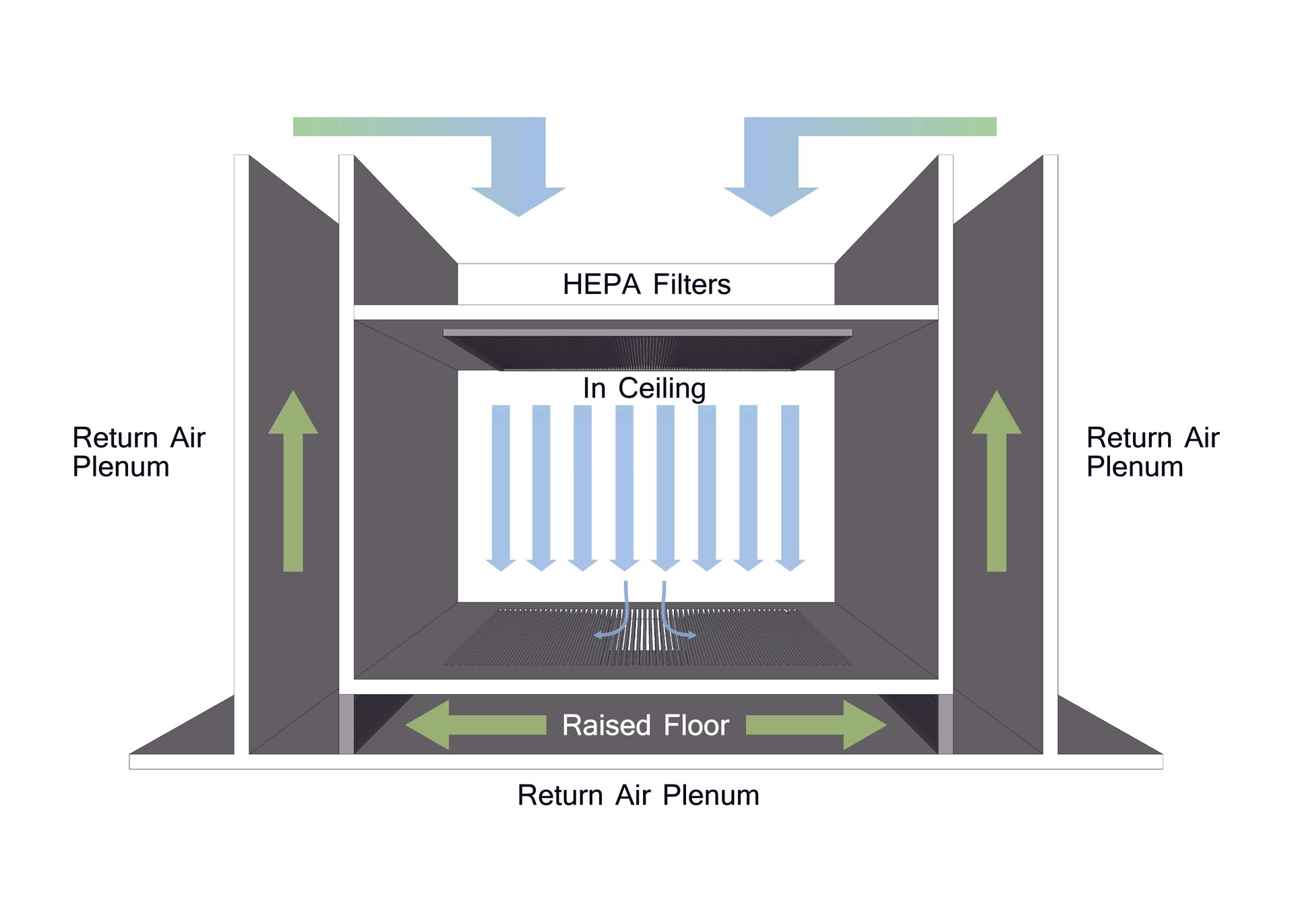
Unidirectional airflow provides a controlled stream of highly filtered air moving in a single, uniform direction at a relatively constant velocity.
Air is typically supplied through a ceiling of HEPA or ULPA filters and flows vertically downward toward low-level return grilles, although horizontal configurations are used in some specialized applications.
The defining characteristics include:
- Uniform airflow direction
- Minimal turbulence within the protected zone
- Continuous flushing of airborne particles
- Rapid removal of contaminants from critical areas
- Reduced opportunity for particle recirculation
This airflow strategy is commonly applied where exposed products or highly sensitive processes require the highest level of contamination control.
1.3 What Is Turbulent Mixed Airflow?
Turbulent mixed airflow, often referred to as non-unidirectional airflow, relies on the continuous mixing of clean supply air with room air to dilute contaminants.
Air is introduced through multiple ceiling diffusers and removed through strategically located return grilles.
Characteristics include:
- Air mixing throughout the room
- Dilution of airborne particles
- Flexible diffuser placement
- Lower airflow velocities
- Reduced installation costs
- Lower energy demand compared with full unidirectional systems
Although airflow directions continuously change, properly designed turbulent systems effectively maintain cleanliness levels appropriate for many cleanroom classifications.
1.4 Why Hybrid Clean Spaces Are Increasingly Used
Not every activity within a cleanroom requires the same level of environmental control.
Hybrid cleanroom designs recognize that contamination risk varies depending on:
- Product exposure
- Process sensitivity
- Personnel activity
- Equipment layout
- Material handling
- Regulatory requirements
Instead of installing full-ceiling unidirectional airflow across an entire facility, engineers often provide localized unidirectional protection above critical process zones while using turbulent airflow in surrounding support areas.
This targeted approach allows contamination control resources to be concentrated where they provide the greatest benefit.
1.5 Typical Hybrid Applications
Hybrid airflow strategies are widely used in facilities where different processes require different environmental conditions.
Examples include:
- Aseptic filling lines with unidirectional airflow over exposed products and turbulent airflow in surrounding rooms
- Pharmaceutical compounding suites with localized clean air protection at critical workstations
- Medical device assembly areas with protected inspection stations
- Semiconductor production areas with mini-environments above sensitive tools
- Laboratory workstations equipped with localized clean air modules
These configurations maintain high cleanliness where necessary while avoiding the cost of supplying unidirectional airflow to the entire room.
1.6 Airflow Interaction in Hybrid Spaces
Designing hybrid cleanrooms requires careful attention to the interaction between airflow patterns.
Potential challenges include:
- Airflow interference
- Turbulence at airflow boundaries
- Particle entrainment
- Pressure imbalance
- Disruption caused by personnel movement
- Equipment-induced airflow disturbances
If turbulent airflow enters the protected unidirectional zone, contaminants may be carried toward critical operations instead of away from them.
Computational Fluid Dynamics (CFD) modeling and airflow visualization studies are commonly used during design to evaluate these interactions before construction.
1.7 The Importance of Airflow Velocity
Maintaining appropriate airflow velocity is essential for effective contamination control.
For unidirectional airflow systems, the objective is to provide sufficient airflow to remove particles without creating excessive turbulence or operator discomfort.
Factors influencing airflow performance include:
- Filter coverage
- Air change rates
- Ceiling height
- Equipment geometry
- Heat loads
- Personnel movement
- Return air placement
Optimizing these variables helps preserve the integrity of the protected airflow zone.
1.8 Energy Efficiency Considerations
Unidirectional airflow systems generally require higher air volumes than turbulent systems, resulting in greater fan energy consumption and increased HVAC operating costs.
Hybrid cleanroom designs can significantly reduce energy demand by limiting high-volume airflow to critical areas only.
Energy-saving strategies include:
- Localized unidirectional airflow canopies
- Fan filter units (FFUs)
- Variable air volume control
- Occupancy-based ventilation adjustments
- High-efficiency EC fan technology
- Optimized return air layouts
Reducing unnecessary airflow while maintaining required cleanliness levels contributes to lower operating costs without compromising product protection.
1.9 Validation and Performance Testing
Hybrid cleanrooms require comprehensive qualification to verify that both airflow strategies perform as intended.
Validation activities typically include:
- Airflow visualization (smoke studies)
- Air velocity measurements
- HEPA filter integrity testing
- Airborne particle counting
- Room pressure verification
- Temperature and humidity measurements
- Airflow balance testing
- Recovery time testing
Smoke visualization is particularly valuable for confirming that unidirectional airflow remains intact around critical process areas and is not disrupted by adjacent turbulent airflow.
1.10 Regulatory and Standards Considerations
Cleanroom airflow design should align with applicable industry standards and regulatory expectations.
Relevant guidance includes:
- ISO 14644 series for cleanroom classification and testing
- EU GMP Annex 1 for the manufacture of sterile medicinal products
- PIC/S GMP guidance
- FDA guidance on aseptic processing
- Industry-specific engineering standards and best practices
Current regulatory guidance emphasizes protecting critical process zones through appropriate airflow design rather than prescribing a single ventilation strategy for every application.
Risk-based contamination control assessments are central to determining the most suitable airflow approach.
1.11 Common Design Challenges
Hybrid airflow systems require close coordination between architectural, mechanical, and process design teams.
Common challenges include:
- Improper diffuser placement
- Inadequate return air locations
- Oversized equipment blocking airflow
- Frequent personnel movement through critical zones
- Thermal plumes from process equipment
- Poor pressure cascade management
Addressing these issues early in the design process helps prevent airflow disturbances that could compromise contamination control.
1.12 Emerging Technologies
Advances in cleanroom engineering continue to improve the performance of hybrid airflow systems.
Emerging technologies include:
- Real-time airflow monitoring sensors
- Smart Building Management System (BMS) integration
- AI-assisted airflow optimization
- Dynamic airflow control based on occupancy
- Digital twin modeling for airflow analysis
- Advanced CFD simulation tools
- High-efficiency fan filter units with intelligent control
These technologies provide greater visibility into cleanroom performance and support proactive optimization throughout the facility lifecycle.
1.13 Selecting the Appropriate Airflow Strategy
There is no universally superior airflow system for every cleanroom application.
The choice between turbulent, unidirectional, or hybrid airflow should be based on a structured assessment of:
- Product sensitivity
- Process criticality
- Contamination risks
- Regulatory requirements
- Facility layout
- Operational flexibility
- Energy consumption
- Lifecycle costs
By aligning airflow design with actual process requirements, organizations can achieve effective contamination control while making efficient use of energy and infrastructure.
Conclusion
Hybrid clean spaces combine the strengths of unidirectional and turbulent airflow to provide targeted contamination control where it is most needed while improving overall facility efficiency. When carefully designed, validated, and maintained, hybrid airflow systems protect critical processes, reduce energy consumption, and support compliance with ISO 14644 and GMP requirements.
As cleanroom technology continues to evolve, hybrid ventilation strategies—supported by advanced modeling, intelligent controls, and continuous performance monitoring—are expected to play an increasingly important role in delivering flexible, high-performance cleanroom environments across a wide range of regulated industries.
Read more here: About Cleanrooms: The ultimate Guide