Micro-Environments and Mini-Environments: When to Use Each Technology

Micro-Environments and Mini-Environments: When to Use Each Technology
1 Introduction
Micro-environments and mini-environments are increasingly common tools for achieving strict contamination control without expanding full-facility cleanroom coverage. Both technologies provide localized protection for critical operations, but they differ significantly in design intent, airflow strategy, complexity, and cost implications.
Selecting the correct approach requires understanding how each environment performs within the broader cleanroom system and where it delivers the greatest operational and regulatory value.
This article clarifies the differences and offers engineering guidance on when each technology is most appropriate under ISO 14644 and GMP expectations.
2 Defining Micro-Environments and Mini-Environments
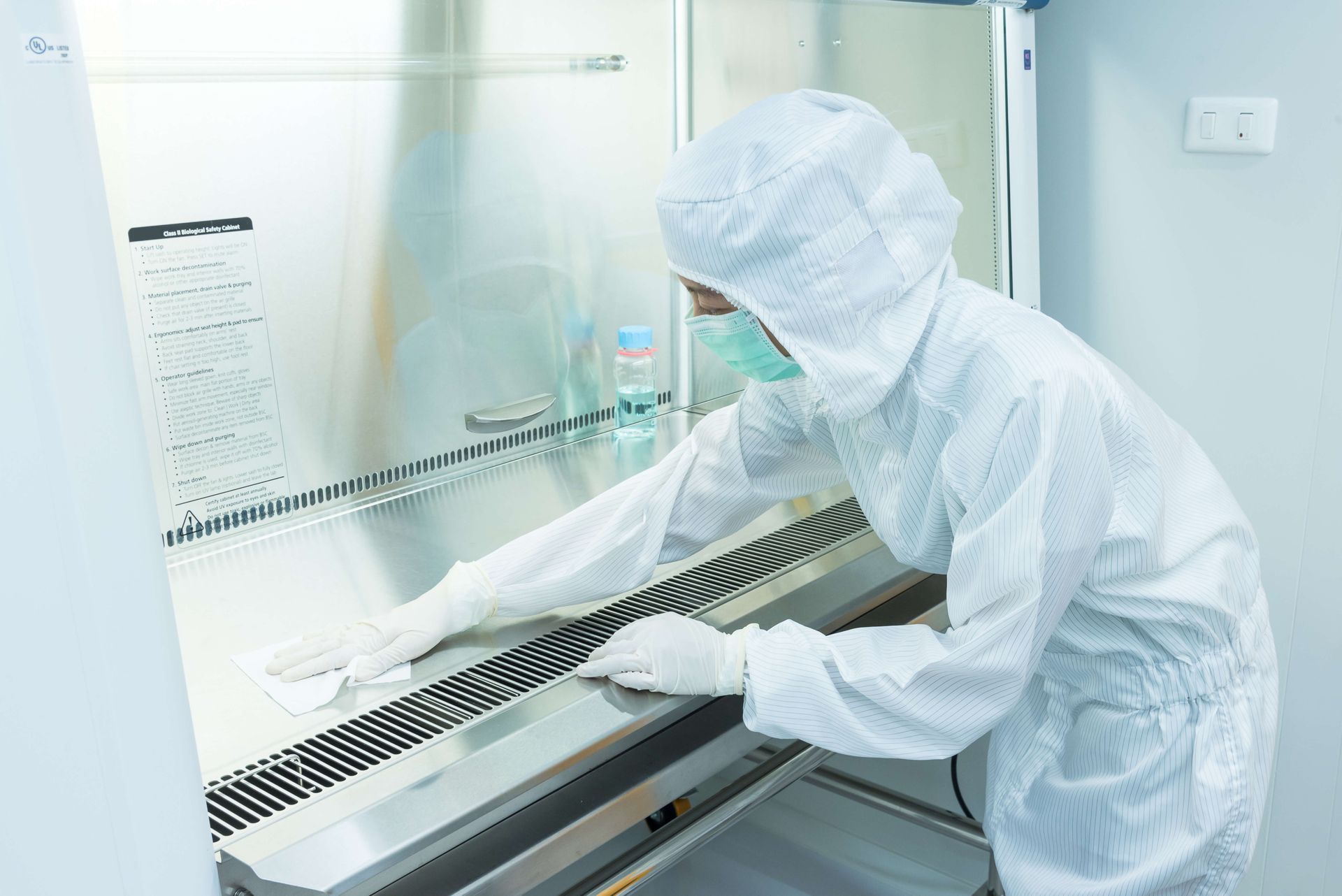
Micro-environments are very small, highly controlled spaces created directly at the point of use. They typically rely on dedicated unidirectional airflow (UDAF) zones—often implemented through laminar flow hoods, isolators, or compact containment modules—to maintain localized cleanliness at ISO Class 5 or better. Their primary function is protecting a single operation, component, or wafer surface from particle deposition or microbial ingress.
Mini-environments, by contrast, are enclosed or semi-enclosed workstation-scale enclosures that isolate equipment or process steps from the surrounding cleanroom. Rather than controlling only the immediate critical surface, mini-environments control the entire process volume. They can maintain ISO Class 1–5 interiors even when located inside a lower-grade cleanroom (e.g., ISO Class 7–8). They often incorporate integrated filtration, temperature and humidity management, purge cycles, access control, and robotic or semi-automated handling.
Both technologies reduce reliance on large cleanrooms by concentrating contamination control where it matters most, but their engineering purpose and level of environmental autonomy differ substantially.
3 Airflow Strategies and Contamination Control Mechanisms
Micro-environments operate on a straightforward principle: high-efficiency unidirectional airflow washes over the critical zone, sweeping particles away from the work surface.
These systems often incorporate:
- HEPA or ULPA filters mounted directly above the zone
- Short airflow paths to minimize turbulence
- Single-pass air with no significant recirculation
- Minimal internal heat loads and simplified controls
Because a micro-environment is typically open on at least one side, cleanliness performance depends heavily on surrounding cleanroom classification, personnel behavior, and localized air velocities. They provide excellent point-of-use protection but limited isolation from external conditions.
Mini-environments use more complex airflow schemes. The enclosure boundaries allow for controlled recirculation with very high air-change rates and precise distribution patterns.
Engineering features commonly include:
- Fully enclosed, gasketed access panels or transfer interfaces
- Dedicated fan-filter units with ULPA filtration
- Internal air recirculation with purge modes for fast clean-down
- Pressure control relative to the host cleanroom
- Integrated thermal management to maintain equipment stability
This controlled microclimate ensures superior protection from personnel-generated and facility-generated contaminants.
Mini-environments can effectively decouple sensitive processes from room-level airflow disturbances, making them suitable for the highest-performance semiconductor, optics, and pharmaceutical aseptic applications.
4 Integration With Facility Cleanliness Levels
The most practical reason to use either technology is to optimize the surrounding facility classification. ISO 14644 allows localized cleanliness zones that exceed the classification of the room as long as they are validated and continuously monitored.
Engineers often use this approach to:
- Reduce the overall area requiring high-grade air supply
- Manage energy consumption more effectively
- Support modular expansion without full cleanroom retrofits
Micro-environments are typically deployed inside ISO Class 5–7 rooms where the ambient conditions are already supportive of the local airflow pattern. They are not intended to function independently of the room’s cleanliness; rather, they sharpen control at critical points.
Mini-environments, conversely, allow highly sensitive processes to operate within much lower-grade facilities. A mini-environment maintaining ISO Class 1–3 inside an ISO Class 7–8 room is common in semiconductor lithography, metrology, and assembly. Its boundary and pressure regime ensure that contaminants from the host cleanroom do not meaningfully affect process yield or sterility.
5 Operator Interaction and Ergonomics
Micro-environments rely on direct human interaction. Personnel work immediately adjacent to the controlled zone, so gowning protocols and operator discipline remain essential. Because access is open or partially open, micro-environments are most suitable for manual operations, short dwell times, and processes requiring continuous operator engagement.
Mini-environments limit human access by design.
Operators typically interact through:
- Glove ports
- Automated load-lock systems
- Robotic wafer or material handling systems
- Sealed transfer chambers
This supports compliance with GMP and semiconductor contamination-control principles by eliminating the most significant contamination vector: personnel. While mini-environments introduce additional capital cost and engineering complexity, they enable far greater consistency in cleanliness performance.
6 Environmental Control Beyond Particulate Contamination
Micro-environments primarily control particles.
Temperature, humidity, and electrostatic conditions are generally governed by the host cleanroom. While localized ionization or temperature shielding may be added, the micro-environment itself is not a fully autonomous climate system.
Mini-environments, by contrast, provide highly stable environmental conditions independent of the surrounding room.
They often incorporate:
- Closed-loop temperature control for equipment thermal loads
- Humidity regulation to protect hygroscopic materials
- Inert-gas purge systems to reduce oxygen or moisture levels
- Integrated ionization to control electrostatic charge
These features are critical in advanced electronics manufacturing, precision optics assembly, and certain biologics applications where even minor environmental fluctuations can affect yield or product quality.
7 Maintenance, Validation, and Monitoring Requirements
Micro-environments are simpler to qualify. Typical validation tasks include airflow velocity mapping, smoke studies, particle counting in the work zone, and filter integrity testing. Monitoring often consists of periodic airborne particle sampling and pressure checks in accordance with ISO 14644-2.
Mini-environments require a more comprehensive validation framework.
Qualification must address:
- Internal airflow patterns and recirculation performance
- Filter loading and fan speed compensation
- Pressure control relative to the host cleanroom
- Automated transfer interfaces and purge cycle verification
- Integrated environmental controls (temperature, humidity, gas purity)
- Continuous monitoring of key parameters
For GMP-regulated operations, mini-environments used for aseptic processing must meet Annex 1 expectations, including demonstrable unidirectional airflow at the critical zone, continuous environmental monitoring, and validated decontamination cycles when applicable.
8 When to Use a Micro-Environment
A micro-environment is often the correct choice when:
- The host room already meets ISO Class 5–7 and provides stable airflow
- The critical operation is manual and small in physical extent
- A laminar flow hood or compact UDAF is sufficient to protect the product
- Frequent access is required without complex material transfer mechanisms
- Thermal loads are minimal and do not require specialized conditioning
- The process risk analysis shows contamination sensitivity but not at the level requiring complete enclosure
Typical applications include sample preparation, manual assembly of precision components, microbiological plating or weighing procedures, contamination-sensitive laboratory work, and any process where local protection is necessary but a full enclosure is not justified.
9 When to Use a Mini-Environment
A mini-environment is recommended when:
- The required cleanliness exceeds what is practical for the room (ISO Class 1–3 interior)
- Personnel contribution to contamination must be minimized or eliminated
- The equipment generates significant thermal loads requiring dedicated control
- Automated handling or robotic motion is part of the process
- Material transfer must be isolated and validated (e.g., load-lock, passthrough)
- Process yield, sterility assurance, or dimensional performance is highly sensitive to environmental variation
Examples include semiconductor lithography, inspection, and assembly tools; precision optics polishing and coating systems; high-resolution metrology stations; isolator-based aseptic filling; and advanced materials research where oxygen or moisture exposure must be prevented.
10 Cost, Scalability, and Life-Cycle Considerations
Micro-environments offer low capital cost, fast deployment, and straightforward maintenance. They are ideal for laboratories or manufacturing cells that require flexibility and frequent reconfiguration.
Mini-environments involve higher upfront investment, custom engineering, and more complex facility interface requirements. However, they allow dramatic reductions in cleanroom square footage and operating cost by decoupling process cleanliness from the room. Over a facility life cycle, mini-environments often provide substantial savings when processes require extremely low particle levels or stable internal microclimates.
11 Conclusion
Micro-environments and mini-environments are complementary tools in modern contamination-control strategy.
Micro-environments deliver efficient point-of-use protection within already-controlled spaces, while mini-environments provide fully autonomous, ultra-clean process volumes capable of outperforming the surrounding cleanroom. Selecting the correct solution requires evaluating process sensitivity, human interaction, environmental stability needs, and room-level cleanliness constraints.
By applying ISO 14644 and GMP principles, designers and operators can deploy the right technology to enhance product quality, improve yield, and optimize facility cost.
Read more here: About Cleanrooms: The ultimate Guide