Particle Deposition Dynamics on Surfaces in ISO-Classified Areas

Particle Deposition Dynamics on Surfaces in ISO-Classified Areas
1. Introduction
Particle deposition is a critical contamination mechanism in ISO-classified cleanrooms, particularly where surface cleanliness directly affects product quality, sterility assurance, or device reliability. While ISO 14644-1 and -2 focus primarily on airborne concentration limits, surface contamination plays an equally important role in cleanroom control strategies—especially in aseptic processing, microelectronics, and high-precision manufacturing.
Understanding particle deposition dynamics enables engineers and operators to design facilities, workflows, and monitoring programs that minimize risk.
This article examines the mechanisms governing deposition, the influence of cleanroom design and operation, and practical strategies for managing surface contamination.
2. Fundamentals of Particle Deposition
Particle deposition occurs when airborne particles migrate toward and settle onto surfaces. The deposition rate depends on both particle characteristics and the local airflow environment.
Primary physical mechanisms include:
- Gravitational settling: Dominant for larger particles (≥5–10 µm), dependent on particle density and air viscosity.
- Turbulent diffusion: Important for smaller particles (<1 µm), where Brownian motion causes random movement toward surfaces.
- Inertial impaction: Occurs when particles cannot follow rapid changes in airflow direction, particularly near obstructions.
- Interception: Occurs when particle trajectories skim near surfaces such as HEPA filter housings or equipment edges.
- Electrostatic effects: Can influence deposition in low-velocity regions or on charged surfaces, though typically secondary in well-grounded facilities.
These mechanisms interplay differently depending on cleanroom grade, flow regime, and surface geometry.
3. Influence of ISO Classification and Airflow Regimes
ISO class does not directly specify surface cleanliness limits, but it strongly influences deposition rates via air cleanliness and airflow characteristics.
ISO 5 (unidirectional flow):
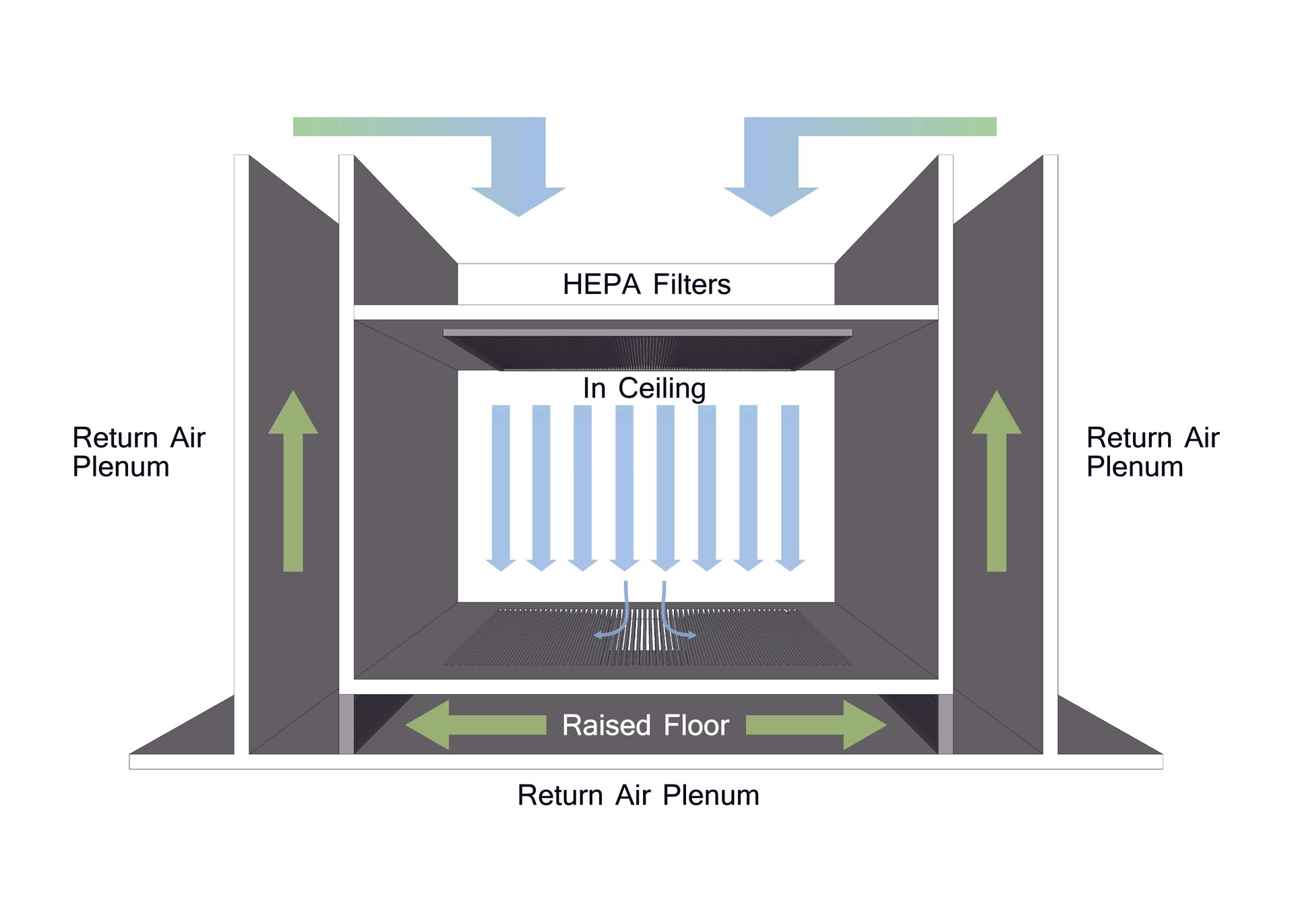
- High airflow velocities (typically 0.36–0.54 m/s) minimize residence time of particles near surfaces.
- Deposition is dominated by interception and impaction, particularly around equipment that disturbs downward flow.
- Well-designed unidirectional zones have low deposition rates on horizontal surfaces.
ISO 7–8 (turbulent-mixed):
- Air changes per hour (ACH) vary from ~20 to >50, depending on process load.
- Turbulence increases residence time and enhances diffusion-driven deposition, especially for submicron particles.
- Large obstructions and heat sources produce localized eddies that increase deposition risk.
Airflow visualization and CFD modelling help identify areas of stagnation, recirculation, and high deposition potential.
4. Role of Surface Orientation and Geometry
Surface orientation has a major effect on deposition dynamics.
- Horizontal upward-facing surfaces (e.g., worktops, equipment housings): Highest deposition due to gravitational settling.
- Vertical surfaces: Lower deposition, dominated by diffusion and interception.
- Recessed or shielded areas: Tend to accumulate particles due to low-velocity “dead zones.”
- Complex geometries: Sharp edges, corners, and cable bundles enhance turbulent deposition and make cleaning more difficult.
Minimizing horizontal and complex surfaces is a cornerstone of hygienic design in EU GMP Annex 1 compliant facilities.
5. Particle Sources and Their Impact on Deposition
Particles that deposit on surfaces originate from multiple sources, each with distinct size distributions and behaviors.
Common sources include:
- Personnel: Largest contributor in most cleanrooms; shedding rates increase with movement and improper gowning.
- Equipment: Motors, bearings, moving parts, and heat-generating components.
- Processes: Powder handling, machining, filling line operations.
- Facility envelope: Door leakage, panel edges, worn seals, and construction defects.
- Cleaning activities: Ironically can elevate deposition if airborne disturbance is excessive or if residues attract particles.
Understanding source contributions is essential for designing monitoring programs and establishing cleaning frequencies.
6. Deposition Velocity and Quantification
Deposition is often expressed using deposition velocity (vd), a parameter that relates airborne particle concentration to surface deposition rate.
The relationship is typically represented as:
Deposition Rate (particles/cm²·h) = Airborne Concentration (particles/m³) × vd
Typical deposition velocities:
- Submicron particles: very low (dominated by diffusion).
- 1–10 µm particles: moderate; influenced by turbulence and settling.
10 µm particles: high; dominated by gravity.
Experimental data and CFD-based estimations can be used to evaluate deposition risk at critical locations.
7. Environmental and Operational Factors Affecting Deposition
Deposition rates depend strongly on local environmental conditions.
Key influencing factors:
- HVAC system performance: Variability in air change rates, HEPA supply uniformity, and pressure cascades.
- Airflow disturbances: Door openings, equipment motion, glovebox operations, and operator movement.
- Thermal plumes: Heat from equipment or personnel can draw contaminated air upward.
- Humidity: Affects particle agglomeration; larger agglomerates settle more quickly.
- Surface electrostatic charge: Can attract fine particles, particularly polymers and textiles.
Operational discipline is therefore essential to keeping deposition rates within acceptable limits.
8. Deposition in Aseptic and Critical Grade A/B Areas
In Grade A unidirectional airflows, surface deposition directly threatens aseptic integrity.
Key considerations:
- Even minor disruptions (e.g., rapid operator hand movements) can generate turbulence and increase deposition.
- Equipment layout should minimize obstructions and preserve unidirectional flow paths.
- Interventions must be minimized; robotic systems or RABS/isolators significantly reduce deposition risk.
- Frequent cleaning of exposed horizontal surfaces is required, validated for removal of particles and residues.
In Grade B support zones, deposition influences airborne contamination levels and therefore overall aseptic performance.
9. Monitoring and Assessing Surface Deposition
ISO 14644-9 and -17 provide structured approaches for assessing surface cleanliness and deposition.
Practical monitoring tools include:
- Surface particle counters (for sensitive manufacturing, e.g., microelectronics).
- Tape-lift or gel tape methods for capturing deposited particles.
- Microscopy-based analysis (optical or SEM) for size distribution studies.
- Settle plates for viable particle deposition, used primarily in GMP environments.
Data from surface monitoring complement airborne data and support risk evaluations for cleaning frequency and intervention design.
10. Minimizing Deposition Through Design
Engineering design plays a critical role in controlling deposition.
Effective design measures include:
- Optimized HEPA placement to maintain uniform flow and minimize recirculation.
- Reducing obstructions in laminar flow zones; placing equipment out of the airflow path where feasible.
- Hygienic design of furniture and equipment, minimizing ledges and horizontal surfaces.
- Sealed cable management to avoid dust-accumulating recesses.
- Material choices that resist electrostatic charging.
These strategies should be evaluated during Design Qualification (DQ) and supported by CFD analysis where appropriate.
11. Operational Controls to Limit Deposition
Operational behavior significantly impacts deposition rates.
Key practices include:
- Controlled movement patterns for personnel to avoid disturbing airflow.
- Minimized interventions and use of automated systems where feasible.
- Validated cleaning frequencies based on deposition risk and monitoring results.
- Gowning discipline, including correct fit and material selection.
- Door management, using airlocks and interlocks to maintain pressure stability.
These controls form part of the facility’s contamination control strategy (CCS).
12. Implications for Cleaning and Disinfection Programs
Understanding deposition informs cleaning strategies and SOP design.
Important considerations:
- Frequency: High-risk areas require more frequent cleaning due to greater deposition load.
- Technique: Wiping patterns and overlap must remove not only microbial but also particulate contamination.
- Tool selection: Low-lint materials and validated pre-saturated wipes reduce particle re-distribution.
- Residue management: Some cleaning agents increase tackiness or static, inadvertently increasing deposition—requiring validation and rotation strategies.
Cleaning validation should demonstrate removal efficiency for relevant particle sizes.
13. Integrating Deposition Data Into CCS and Lifecycle Management
Deposition knowledge supports long-term contamination control planning.
Lifecycle measures include:
- Trending surface contamination levels alongside airborne data.
- Evaluating deposition patterns after layout changes or new equipment installation.
- Trigger-based cleaning enhancements following deviations or adverse trends.
- Design updates when chronic deposition hot spots persist.
- Reassessment during requalification to verify that deposition behavior remains consistent.
This integrated approach aligns with the continuous improvement expectations of EU GMP Annex 1 and ISO 14644-2.
14. Conclusion
Particle deposition on surfaces in ISO-classified cleanrooms is a multidimensional phenomenon shaped by airflow behavior, particle physics, facility design, and operational practice. By understanding deposition dynamics and integrating this knowledge into monitoring, cleaning, and CCS strategies, facilities can significantly reduce contamination risk, support regulatory compliance, and enhance long-term cleanroom performance.
A disciplined, engineering-driven approach ensures that surface cleanliness is not an afterthought but a controlled and verifiable element of the cleanroom environment.
Read more here: About Cleanrooms: The ultimate Guide